
Introduction and Working Thesis
Genesis 10 presents the nations as an ordered religious, political, and geographical world. Each people receives a name, a language, a territory, and a place under heaven (Gen 10:5, 20, 31). The Torah later explains that this order has a heavenly side: the nations were apportioned under the host of heaven, while Jacob remained the LORD’s own portion (Deut 4:19–20; 32:8–9).
This commentary reads the Table of Nations within the Torah’s received form, peshat first, then through its canonical development in the Tanakh, Second Temple Judaism, the Apostolic Writings, and later Jewish interpretation. Genesis 10 is not prophecy, so the study treats it as an account of peoples, territories, boundaries, and heavenly administration.
Working thesis. Within the ordered world of Genesis 10–11, the Euphrates — “the River” — (also called “the Flood”) is a decisive boundary. The house of Terah dwelt “beyond the River” and served other gods there (Josh 24:2). Abram the ʿIvri, “the one who crossed over,” passed from the realm of the nations into the land the LORD swore to his seed, a land whose outer limit the Torah itself fixes at “the great river, the river Euphrates” (Gen 15:18).
A note on sources. The geography of this commentary rests on the Hebrew Bible and the Septuagint. Jubilees is not used to establish territory or allotment; where any Second Temple text is cited, its date and sectarian setting are named and it is treated as a witness, not as a control on the peshat.
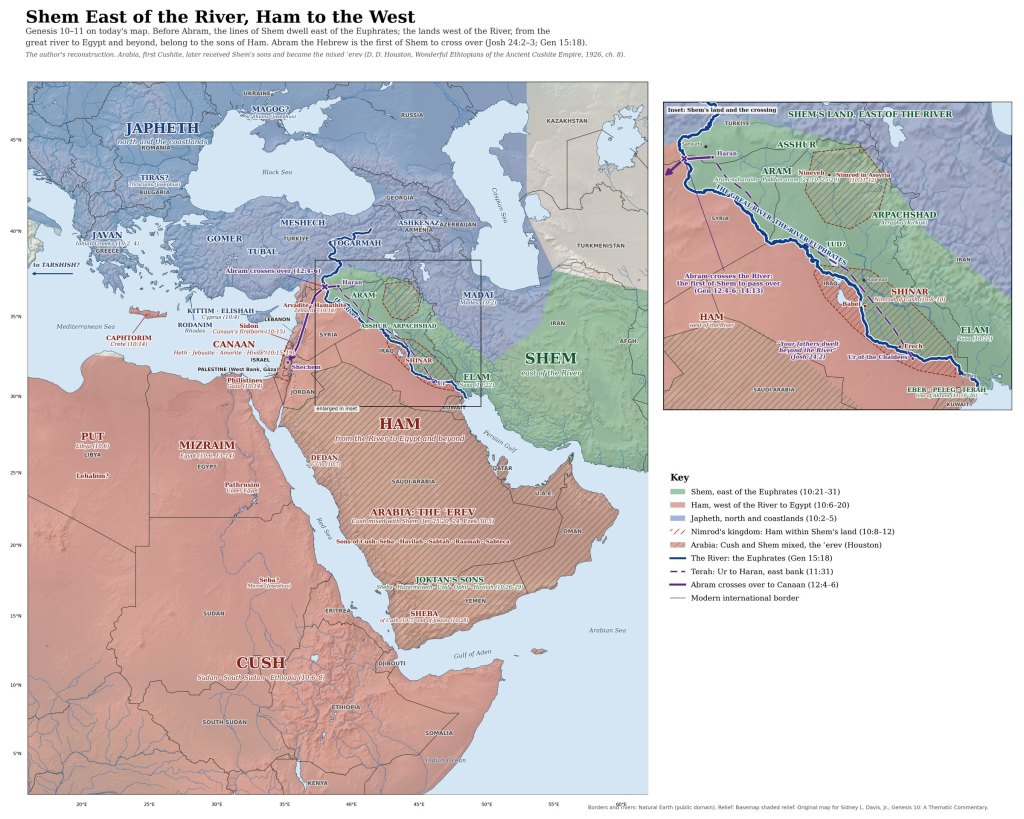
Plate 1: Shem East of the River, Ham to the West
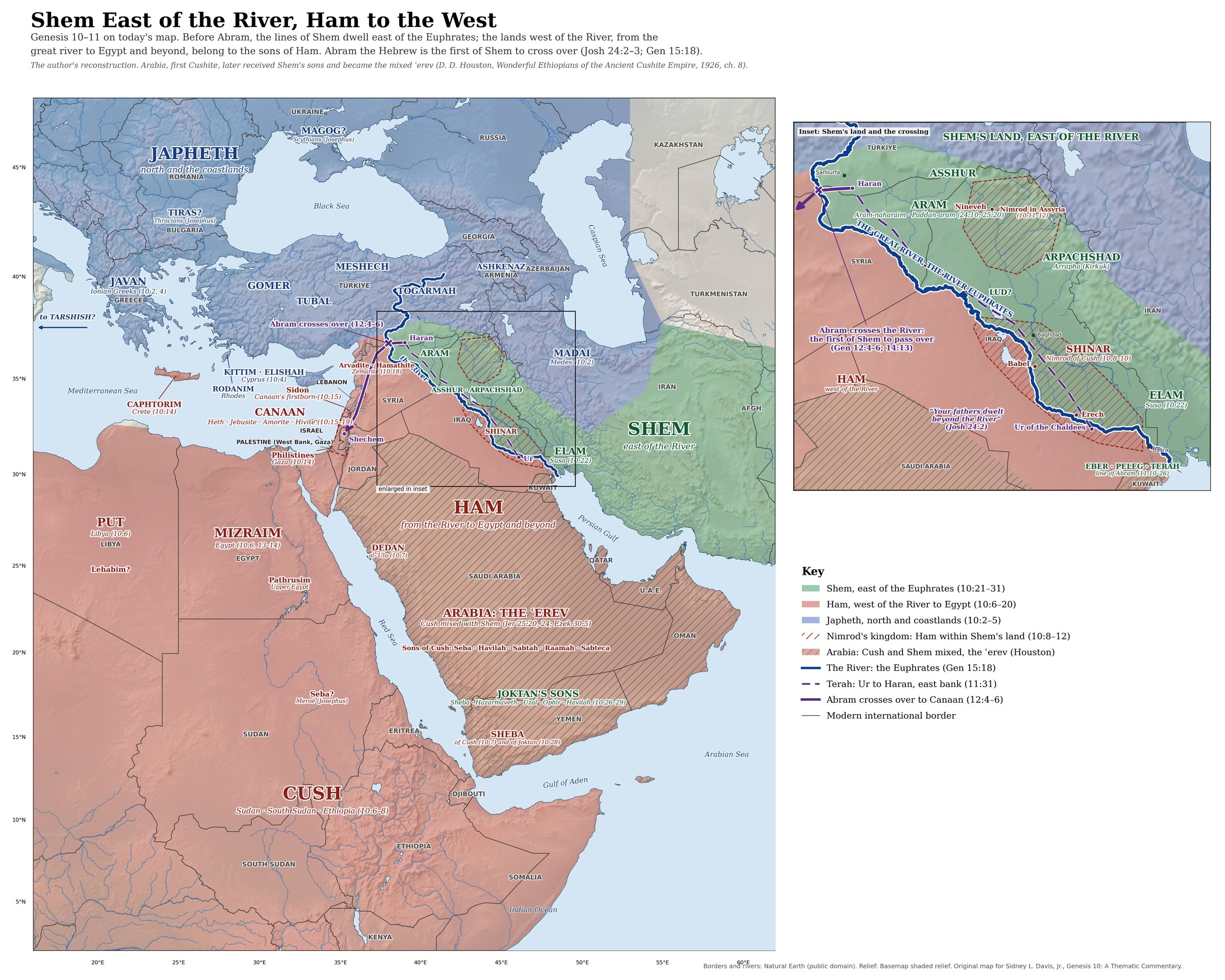
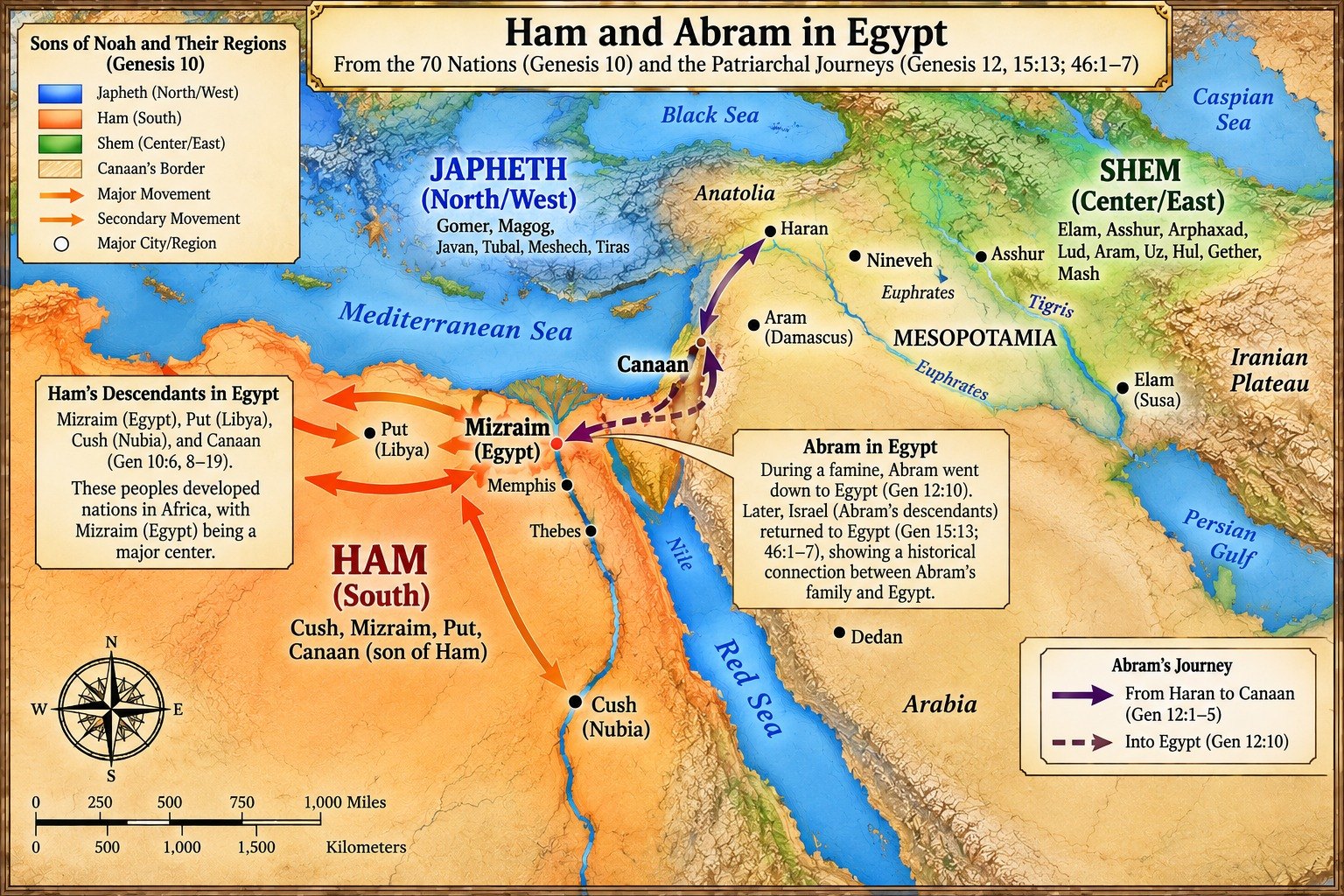
Before Abram, the lines of Shem dwell east of the Euphrates, from Aram-naharaim and Haran down through Asshur, Arpachshad, and Chaldea to Elam. West of the River, from the great river to Egypt and beyond, the land belongs to the sons of Ham: Canaan, Mizraim, Put, and Cush. Arabia was Cushite first (10:7) and later received the sons of Joktan, becoming the mixed people the prophets call the ʿerev. Nimrod of Cush is the one Hamite kingdom planted in Shem’s land (10:8–12). Abram the ʿIvri is the first of Shem to cross over (Josh 24:2–3; Gen 12:4–6; 14:13), into the land later promised to his seed from the river of Egypt to the great river, the river Euphrates (Gen 15:18).
| Zone | Peoples of Genesis 10 | Modern nations | Textual anchor |
|---|---|---|---|
| East of the River: Shem | Elam; Asshur; Arpachshad; Lud?; Aram; the line of Eber, Peleg, and Terah | Iraq east of the Euphrates, Iran, northeastern Syria, southeastern Türkiye (Haran) | Arpachshad at Arrapha (Kirkuk); Aram at Aram-naharaim and Paddan-aram (24:10; 25:20); the fathers “beyond the River” (Josh 24:2) |
| East of the River: Ham within Shem’s land | Nimrod: Babel, Erech, Accad in Shinar; Nineveh and Calah in Assyria | Iraq | The one Hamite kingdom east of the River (10:8–12) |
| West of the River: Canaan | Sidon, Heth, Jebusite, Amorite, Girgashite, Hivite, Arkite, Sinite, Arvadite, Zemarite, Hamathite | Israel, the Palestinian territories, Lebanon, western Syria | Border traced in 10:19 |
| West of the River: Mizraim | Ludim, Anamim, Lehabim, Naphtuhim, Pathrusim, Casluhim, Caphtorim; the Philistines | Egypt, Libya, Gaza, Crete | 10:13–14 |
| West of the River: Put | Put | Libya | 10:6 |
| West of the River: Cush | Cush | Sudan, South Sudan, Ethiopia | 10:6–8 |
| Arabia: Cush, then Shem mixed in | Sons of Cush: Seba, Havilah, Sabtah, Raamah, Sabteca, Sheba, Dedan. Sons of Joktan: Sheba, Hazarmaveth, Uzal, Ophir, Havilah, and others | Saudi Arabia, Yemen, Oman, the Gulf states | Sheba and Havilah named in both lines (10:7, 28–29); the ʿerev (Jer 25:20, 24; Ezek 30:5) |
| North: Japheth | Gomer, Magog?, Madai, Javan, Tubal, Meshech, Tiras?; Ashkenaz, Riphath, Togarmah; Elishah, Tarshish, Kittim, Rodanim | Türkiye, Greece, Cyprus, Armenia, Georgia, Bulgaria, Ukraine; northwestern Iran (Media) | 10:2–5 |
Arabia and the ʿerev
The western and southern placements later attached to Semitic names (Aram at Damascus, Lud at Lydia, Joktan’s sons in South Arabia) reflect a later stage, after Shem’s descendants spread from east of the River and mixed with the Cushite and Hamite peoples already there, mostly in the Arabian Peninsula. Drusilla Dunjee Houston argued that “Arabia was originally settled by two distinct races, an earlier Cushite Ethiopian race and a later Semitic Arabian,” and that “the Cushites were the original Arabians and dwelt there before Abraham came to Canaan” (Wonderful Ethiopians of the Ancient Cushite Empire, Book 1 [1926; repr., Baltimore: Black Classic Press, 1985], ch. 8, “Arabia and Her Ancient Races,” 113).
Genesis 10 itself records the overlap. Sheba and Havilah are named both among the sons of Cush (10:7) and among the sons of Joktan (10:28–29). The prophets name the resulting population with the root ʿrb, “to mix”: Jeremiah sets “all the kings of Arabia (ʿarav)” beside “all the kings of the mingled people (ha-ʿerev) that dwell in the desert” (Jer 25:24; compare 25:20). Ezekiel lists “Cush, Put, Lud, and all the mingled people (ha-ʿerev)” together (Ezek 30:5), and 1 Kings 10:15 (MT) speaks of “all the kings of the ʿerev” where 2 Chronicles 9:14 reads “the kings of Arabia.”
This Arabian ʿerev is distinct from the ʿerev rav, the “mixed multitude” of Egyptians and others who went up from Egypt with Israel (Exod 12:38; compare Neh 13:3).
Interpretive Framework: The Nations and the Host of Heaven
The Torah treats the nations as apportioned under heavenly rulers and Israel as the LORD’s own inheritance. Three Deuteronomy texts establish this, and later Scripture and Jewish tradition develop it.
Deuteronomy 4:19–20: Allotted to the Nations, Taken for Himself
Moses forbids Israel to worship the sun, moon, stars, and “all the host of heaven, which the LORD thy God hath divided (ḥalaq) unto all nations under the whole heaven” (4:19). The verb ḥalaq is the language of apportioning an inheritance.
Verse 20 supplies the contrast: “But the LORD hath taken you, and brought you forth out of the iron furnace … to be unto him a people of inheritance.” The nations receive the host of heaven as their portion. Israel is received by the LORD as his.
Deuteronomy 29:25 (Eng. 29:26): Gods Not Allotted to Israel
Israel’s apostasy is described as serving “gods whom they knew not, and whom he had not given (ḥalaq) unto them.” The same verb appears again. Idolatry for Israel is not merely false worship; it is going after a portion that was never Israel’s.
Deuteronomy 32:8–9: The Witnesses to the Text
The wording of 32:8 differs among the ancient witnesses, and the heavenly-administration reading depends on which is followed.
| Witness | Date | Reading of 32:8b |
|---|---|---|
| Masoretic Text | medieval manuscripts, proto-MT tradition | “according to the number of the children of Israel” (bĕnê yiśʿāʾēl) |
| 4QDeut^j (Qumran) | 1st c. BCE | “according to the number of the sons of God” (bĕnê ʾĕlōhîm) |
| Septuagint | 3rd–2nd c. BCE | “according to the number of the angels of God” (angelōn theou); some witnesses read “sons of God” |
| Targum Onkelos | final form later | follows the MT, “the number of the sons of Israel” |
| Targum Pseudo-Jonathan | late | combines both: seventy angels and seventy nations at the dispersion |
Both readings place Israel at the center. Jewish interpretation preserves the MT sense through the number seventy: Rashi on 32:8 links the bounds of the peoples to the seventy souls of Jacob who went down to Egypt (Gen 46:27; Exod 1:5). On the Qumran and Septuagint reading, the nations are set under the sons of God, while Israel stands under the LORD directly.
Verse 9 governs either reading: “For the LORD’s portion is his people; Jacob is the lot of his inheritance.” The division of the nations is told in order to say where Israel stands.
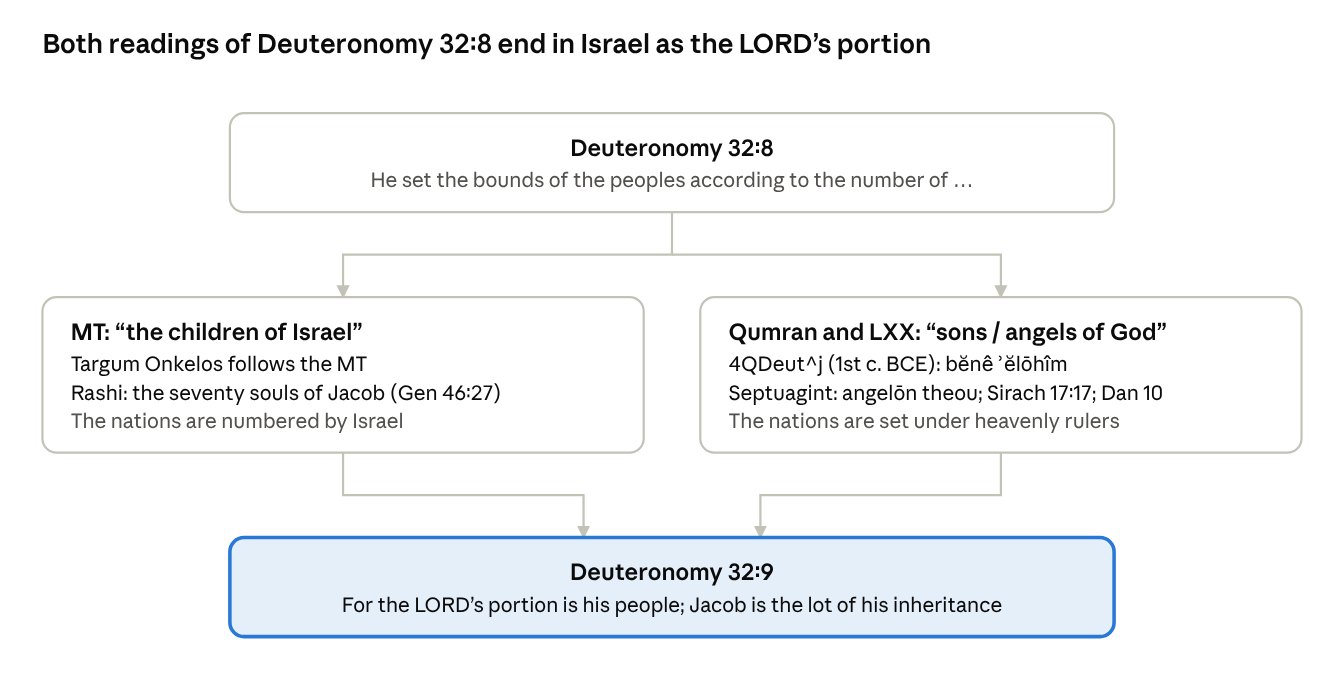
Whichever reading of 32:8 is followed, verse 9 places Israel outside the apportionment as the LORD’s own inheritance.
Canonical Development in the Tanakh
- Psalm 82. God stands in the divine council and judges the ʾĕlōhîm who judge unjustly (82:1–2). They will “die like men” (82:7), and the psalm closes: “Arise, O God, judge the earth: for thou shalt inherit (tinḥal) all nations” (82:8).
- Daniel 10–12. The sarim appear by name: the prince of Persia and the prince of Javan, Greece (10:13, 20). Javan is the son of Japheth in Genesis 10:2, so Daniel’s heavenly geography follows the Table of Nations. Michael is “your prince” (10:21) and “the great prince which standeth for the children of thy people” (12:1).
Second Temple Witnesses
- Sirach 17:17 (c. 180 BCE): for every nation God appointed a ruler, but Israel is the Lord’s portion. This is a direct reading of Deuteronomy 32:8–9.
- Second Temple Judaism was not uniform here. Sirach has no ruler set over Israel, while Daniel gives Israel a heavenly prince in Michael. Each witness is read on its own evidence.
The Seventy Nations
The Masoretic Table of Nations names seventy descendants: fourteen from Japheth, thirty from Ham, and twenty-six from Shem. The Septuagint adds Elisa among Japheth’s sons (10:2) and Kainan in Shem’s line (10:24), yielding seventy-two.
Jewish interpretation preserves the seventy. The Talmud links the seventy bulls of Sukkot to the seventy nations (b. Sukkah 55b). The seventy souls of Jacob (Gen 46:27; Deut 10:22) correspond to them, so Israel’s household mirrors the world it is set among.
The Apostolic Writings
- Acts 17:26. Paul tells the Athenians that God made every nation of men and set the bounds of their habitation. The wording draws on Deuteronomy 32:8 in the Septuagint, and Paul speaks it to the nations as a Jewish account of their place under heaven.
- Ephesians 6:12; Colossians 1:16. Paul’s principalities, powers, and rulers belong to this Jewish category of heavenly authorities over the nations.
- Luke 10:1. The manuscripts divide between seventy and seventy-two sent out. Interpreters have noted that the split mirrors the Masoretic and Septuagint counts of the nations. This is a possible echo, not a demonstrated one.
The Literary Shape of Genesis 10
Genesis 10 is a toledot section, “the generations of the sons of Noah” (10:1), and it is built to hand the story on to Shem and then to Abram.
The Order: Japheth, Ham, Shem
The chapter reverses the order of 10:1 (“Shem, Ham, and Japheth”). Japheth comes first, Ham second, and Shem last. Genesis regularly treats the line it is setting aside first and the chosen line last: Cain before Seth (4–5), Ishmael before Isaac (25:12–19), Esau before Jacob (36–37). Placing Shem last lets his line run straight into Genesis 11 and to Abram.
The Three Colophons
Each branch closes with the same formula: by their families, their languages, their lands, and their nations (10:5, 20, 31). The four terms name the identity the commentary follows throughout: kinship, language, territory, and political order. Verse 32 closes the whole: “by these were the nations divided in the earth after the flood.”
The colophon for Shem (10:31) is identical to those for Japheth and Ham. The text therefore records Shem’s descendants as settled peoples in their own lands, just as it does the others.
Placement Before Babel
Genesis 10 stands before the Babel narrative (11:1–9), though Babel explains how the dispersion came about. The Table speaks of languages (10:5, 20, 31) while 11:1 begins with “one language.” The order is thematic, not chronological: Genesis first shows the finished map, then tells how it was drawn.
Two hinges join the chapters. Peleg’s name is explained by “in his days was the earth divided” (10:25), which points toward 11:8–9. Nimrod’s kingdom begins at Babel in the land of Shinar (10:10), the place where the tower is built (11:2).
Canonical Repetition
The Chronicler reproduces the Table almost entire in 1 Chronicles 1:4–27, carrying it straight on to “Abram; the same is Abraham.” Israel’s own history after the exile begins by placing Israel among the seventy nations.
Plate 2: Sites and Routes of Genesis 10–11
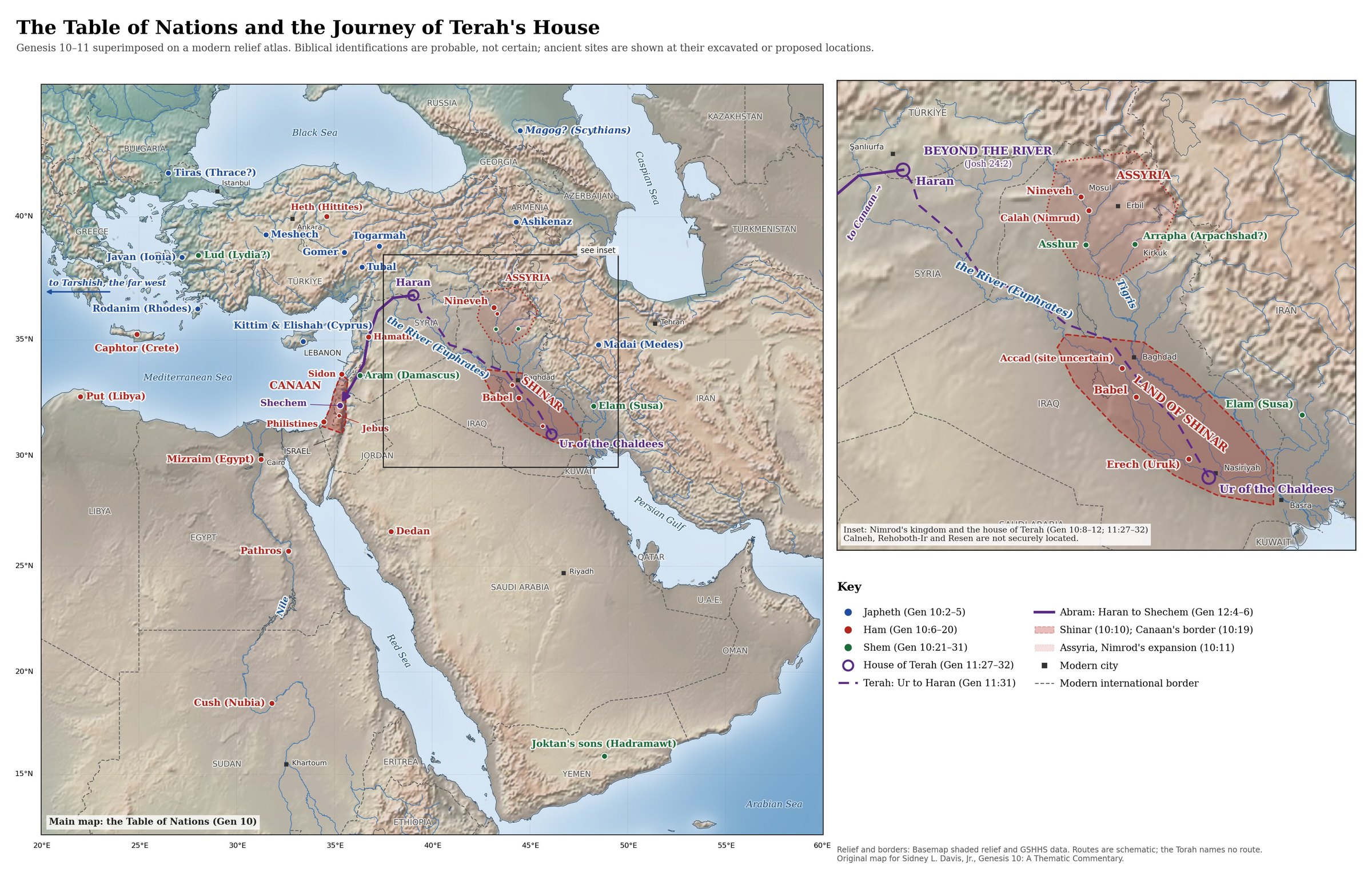
The main map places the peoples of Genesis 10 on the modern relief of the Near East, colored by branch: Japheth in blue, Ham in red, Shem in green. Present-day countries, borders, and cities are shown in gray. The inset enlarges Mesopotamia, where Nimrod’s kingdom in Shinar and its expansion into Assyria (10:10–12) overlap the homeland of Terah’s house at Ur and Haran (11:28–31). The modern cities make the ancient sites easy to find: Nineveh lies across the Tigris from Mosul, Arrapha beneath Kirkuk, Ur near Nasiriyah, and Haran south of Şanlıurfa.
Japheth: The North and the Coastlands (10:1–5)
Japheth’s peoples occupy the outer ring of the biblical map: Anatolia, the Aegean, the Mediterranean islands, and the Iranian plateau. They are named first and briefly, as the peoples farthest from Israel’s land.
The Sons and Their Peoples
| Name | Probable people or region | Basis |
|---|---|---|
| Gomer | Cimmerians, Anatolia | Assyrian Gimirrai; Ezek 38:6 |
| Magog | uncertain; Josephus: Scythians | Josephus, Ant. 1.123; Ezek 38:2 |
| Madai | Medes, Iranian plateau | consistent biblical usage (2 Kgs 17:6; Dan 5:28) |
| Javan | Ionian Greeks | Dan 8:21 (“the king of Javan”); Isa 66:19 |
| Tubal, Meshech | Tabal and Mushku, central and eastern Anatolia | Assyrian records; Ezek 27:13 |
| Tiras | Josephus: Thracians | Josephus, Ant. 1.125 |
Gomer’s sons are Ashkenaz, Riphath, and Togarmah (10:3). Ashkenaz is linked with the Scythians and appears in Jeremiah 51:27. Togarmah is a horse-trading people of Anatolia (Ezek 27:14).
Javan’s sons name the sea world (10:4). Elishah is usually identified with Alashiya on Cyprus. Tarshish lies at the far western edge, the place Jonah sailed toward to flee the LORD (Jonah 1:3). Kittim is Kition on Cyprus, and Dodanim appears as Rodanim, Rhodes, in 1 Chronicles 1:7 and the Septuagint.
“The Isles of the Nations” (10:5)
Verse 5 contains the first occurrence of goyim, “nations,” in the Bible: “By these were the isles of the Gentiles divided in their lands.” The ʾiyyîm are coastlands and islands, the maritime edge of the known world. The word goyim thus enters Scripture as the name of organized peoples in their own territories, not as a term of contempt.
Japheth and the Tents of Shem
Noah’s blessing frames Japheth’s place: “God shall enlarge Japheth, and he shall dwell in the tents of Shem” (Gen 9:27). Japheth is enlarged over wide territory, but his blessing is to come and dwell within Shem’s tents, not to replace Shem.
Jewish interpretation preserves this order. The Talmud reads “the beauty of Japheth in the tents of Shem” as permission to write the Torah in Greek, Javan’s language (b. Megillah 9b). Japheth’s gift is received into Israel’s house, and Israel’s house remains Shem’s.
Canonical Recurrence
Japheth’s names return in the prophets as the far nations. Meshech, Tubal, Gomer, and Togarmah gather with Gog of the land of Magog (Ezek 38:2–6). Tarshish, Tubal, Javan, and the isles are the distant nations that have not heard of the LORD’s fame (Isa 66:19). In both, the nations are still known by the names Genesis 10 gave them.
Ham: Kingdoms, Egypt, and Canaan (10:6–20)
Ham’s section is the longest and the most political. It names the peoples Israel will meet as powers: Egypt, the kingdoms of Shinar and Assyria, the Philistines, and the Canaanites in the land itself.
The Four Sons (10:6–7)
Cush, Mizraim, Put, and Canaan stand for Nubia, Egypt, Libya, and the land between the Jordan and the sea. Egypt is later called “the land of Ham” (Ps 105:23, 27). Cush’s sons and grandsons, including Sheba and Dedan (10:7), reach into Arabia along the Red Sea.
Nimrod and the First Kingdom (10:8–12)
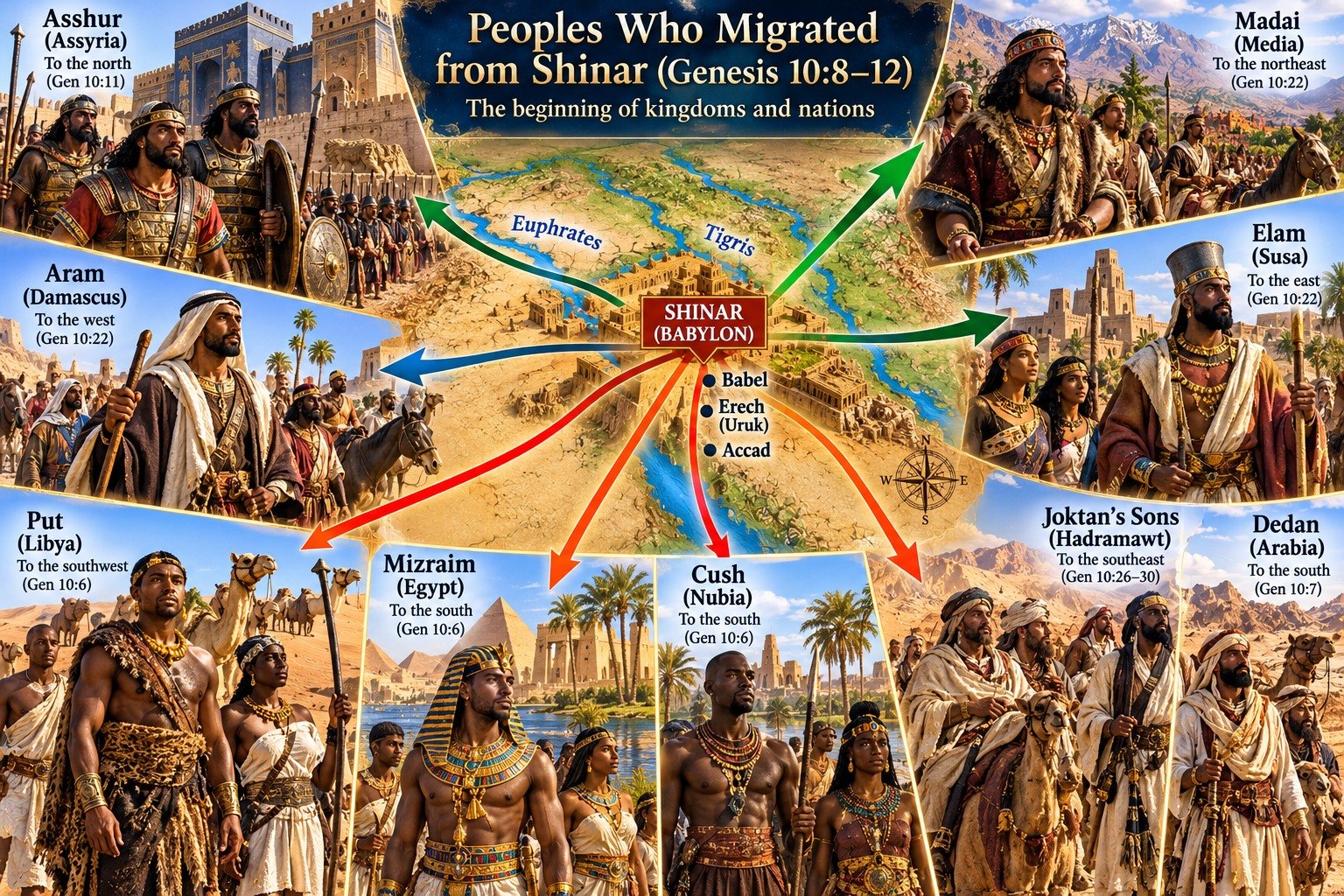
Nimrod “began to be a mighty one (gibbōr) in the earth” (10:8). He is the first person in Scripture said to have a mamlakah, a kingdom (10:10). His political order has a beginning, a center, and an expansion.
- The center: “the beginning of his kingdom was Babel, and Erech, and Accad, and Calneh, in the land of Shinar” (10:10). Erech is Uruk and Accad is Akkad, the great cities of southern Mesopotamia.
- The expansion: “Out of that land went forth Asshur, and builded Nineveh” (10:11, KJV). Many read the Hebrew as “he went forth to Assyria,” making Nimrod the builder. Micah 5:6 supports this, setting “the land of Assyria” parallel to “the land of Nimrod.”
- The phrase “before the LORD” (10:9). The words are ambiguous in isolation. Jewish interpretation reads them as defiance: Josephus makes Nimrod the instigator of the tower who turned the people toward tyranny (Ant. 1.113–114), and the Talmud derives his name from marad, “rebel,” as one who led the world to rebel against God’s rule (b. Pesaḥim 94b).
The religious, political, and geographical lines meet in Nimrod. Babel in Shinar is both the seat of the first kingdom and the site of the tower (11:2). Babylon and Assyria, the empires that later exile Israel, both trace back to his kingdom.
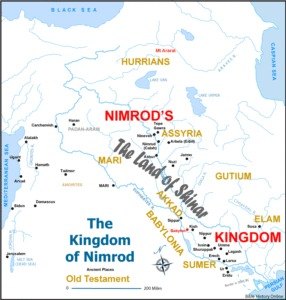
Genesis 10:10–11 keeps the two regions distinct: the kingdom begins in Shinar, the southern plain, and goes out from there to Assyria. Ur and Haran, the two cities of Terah’s house, both lie within the reach of that kingdom.
Mizraim and the Philistines (10:13–14)
Mizraim’s sons include Pathrusim, the people of Pathros in Upper Egypt, and Caphtorim. The Philistines are said to come from Casluhim. Amos 9:7 traces the Philistines to Caphtor, usually identified with Crete. The peoples on Israel’s southwestern coast are thus placed within Ham’s line.
Canaan and the Only Traced Border (10:15–19)
Canaan’s eleven descendants are listed by people: Sidon his firstborn, Heth, the Jebusite, the Amorite, the Girgasite, the Hivite, the Arkite, the Sinite, the Arvadite, the Zemarite, and the Hamathite.
Then “the families of the Canaanites spread abroad” (10:18). The verb is pûs, the same root as the scattering at Babel (11:4, 8, 9).
Canaan is the only people in the chapter whose border is traced: from Sidon toward Gerar and Gaza, then toward Sodom, Gomorrah, Admah, and Zeboim, as far as Lasha (10:19). The Torah marks this territory with care because it is the land the narrative is heading toward.
Canonical Development: Canaan and the Land
- Noah’s words place Canaan under Shem (9:25–26) before the Table begins.
- When Abram enters the land, “the Canaanite was then in the land” (12:6).
- The LORD gives the land to Abram’s seed, and its peoples are named (15:18–21). The handover waits because “the iniquity of the Amorites is not yet full” (15:16). The ground is moral and religious, not mere conquest.
- Leviticus 18:3, 24–28 names “the doings of the land of Canaan” as the practices for which the land expels its inhabitants. Numbers 34:1–12 then redraws Canaan’s border as Israel’s inheritance.
Shem: The Children of Eber (10:21–32)
Shem’s section is introduced by reference to a descendant five generations later: “Unto Shem also, the father of all the children of Eber … even to him were children born” (10:21). Before naming Shem’s sons, the text tells the reader that Shem matters as the ancestor of the Hebrews.
The same verse calls Shem “the brother of Japheth the elder.” The Hebrew can mean either that Japheth is the elder or that Shem is Japheth’s elder brother. The ambiguity does not affect the line’s role.
The Five Sons (10:22)
| Son | Probable people or region | Notes |
|---|---|---|
| Elam | Elam, east of the Tigris (Susa) | the easternmost of Shem’s peoples |
| Asshur | Assyria, upper Tigris | compare Nimrod’s expansion into Assyria (10:11) |
| Arpachshad | no settlement named in the text | the line of Eber, Peleg, and Abram; see below |
| Lud | uncertain; Josephus: Lydians | Ant. 1.144 |
| Aram | the Arameans of upper Mesopotamia, between the rivers | Aram-naharaim, Paddan-aram; Damascus only after later migration |
Aram’s sons are Uz, Hul, Gether, and Mash (10:23). Uz is the homeland of Job (Job 1:1).
At the dispersion from Babel, Shem’s sons settle east of the Euphrates: Elam beyond the Tigris, Asshur on the upper Tigris, Arpachshad toward Chaldea, and Aram in Aram-naharaim between the rivers (24:10; 25:20). The later Aramean states west of the Euphrates, such as Damascus and Hamath, and the Joktanites of southern Arabia are the fruit of subsequent migrations, a second wave of movement, not of the original dispersion at Babel. In Genesis 11 and Joshua 24, the house of Terah is still beyond the River when Abram, the first of Shem to cross over, enters the land of Ham.
Arpachshad (10:22, 24)
The Hebrew Bible names no city, region, or river for Arpachshad. Genesis 10:22, 24 and 11:10–13 give only his genealogy. Any location is therefore a historical-geographic inference, not a statement of the text.
The inference points east of the Euphrates:
- Arrapha. Many interpreters, from Bochart and Michaelis onward, connect the name with Arrapha in the Kirkuk region, east of the Tigris.
- Kasdim. The ending of the name has long been compared with Kaśdîm, the Chaldeans of southern Mesopotamia.
- Josephus. Josephus says that Arphaxad gave his name to the Arphaxadeans, “now called Chaldeans” (Ant. 1.144).
The Chaldean association coheres with Genesis 11:28, 31, where Arpachshad’s descendant Terah lives in “Ur of the Chaldees.” The text never names Arpachshad’s land, but the line that descends from him is first located in Chaldea.
Shelah, Eber, and the Two Branches (10:24–25)
Arpachshad begets Shelah, and Shelah begets Eber. Eber is the eponym of the ʿIvrîm, the Hebrews, and his name shares the root ʿbr, “to cross over” or “the region beyond.” Balaam later names Eber as a people (Num 24:24).
Eber has two sons, and the line divides:
- Peleg: “for in his days was the earth divided (niflĕgah)” (10:25). Rashi, following Seder Olam, places the dispersion of Babel at the end of Peleg’s days. Peleg’s line is the one Genesis 11 follows to Abram.
- Joktan: his thirteen sons are the peoples of southern Arabia, including Hazarmaveth (Hadramawt), Sheba, and Ophir (10:26–29).
The Joktanite Settlement (10:30)
The Joktanites are the only Semitic group whose dwelling the text locates: “from Mesha, as thou goest unto Sephar a mount of the east” (10:30). Verse 31 then gives Shem the same colophon as Japheth and Ham. Shem’s descendants are settled peoples in their own lands, and the chapter closes by naming them all as nations divided in the earth after the flood (10:32).
Genesis 11:1–9: Babel and the Dispersion
Babel tells how the ordered map of Genesis 10 came about. Humanity tried to remain one people in one place under one name, and the LORD divided them into the nations.
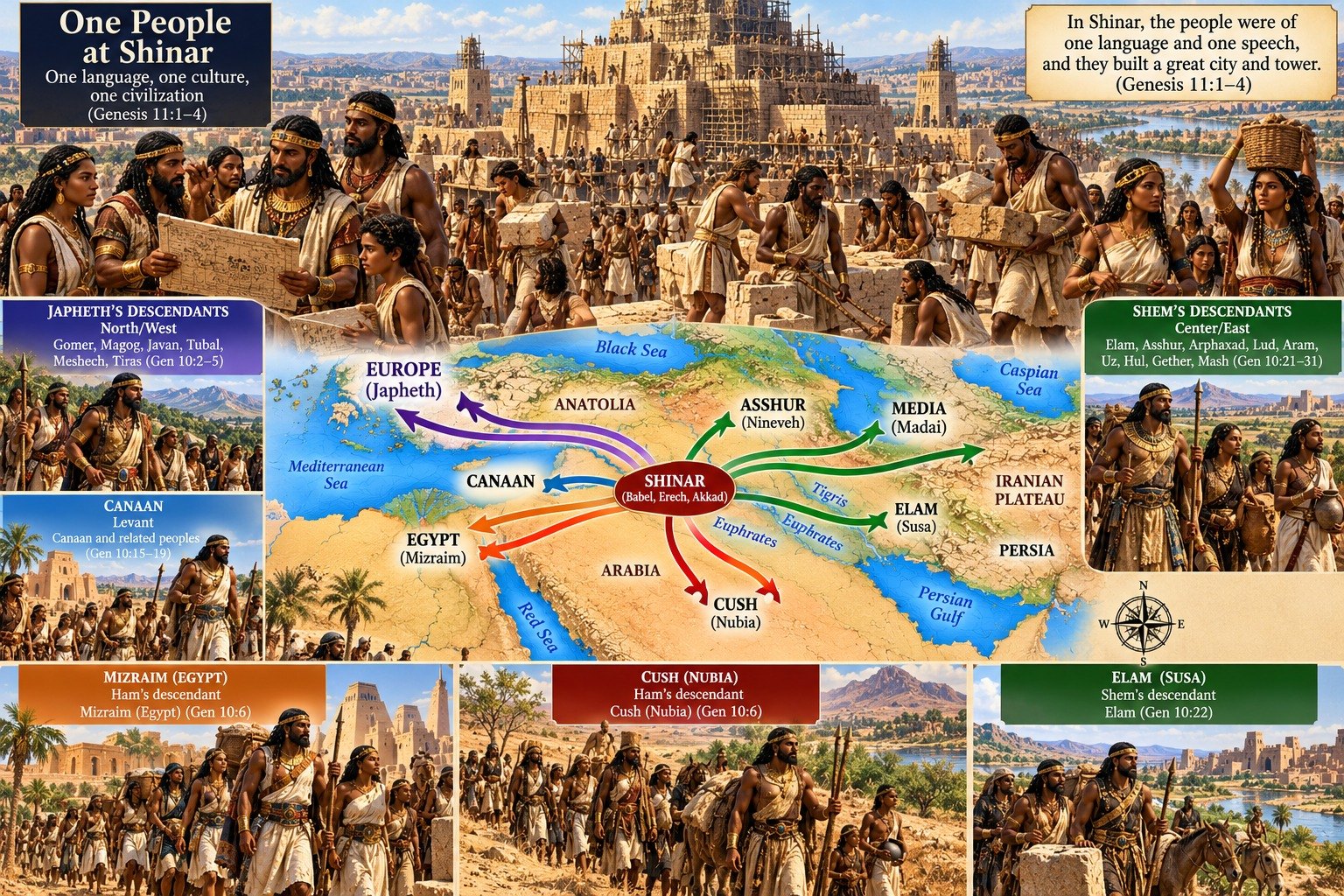
One Language in Shinar (11:1–2)
“The whole earth was of one language (śāpāh ʾĕḥāt), and of one speech” (11:1). As they journeyed miqqedem, “from the east” or “eastward,” they settled in a plain in the land of Shinar. Shinar is Nimrod’s land (10:10), so Babel stands at the center of the first kingdom.
The Project (11:3–4)
The builders use brick for stone and bitumen for mortar (11:3), the materials of Mesopotamia, not of Canaan. Their aims are stated:
- A city and a tower “whose top may reach unto heaven”: a political center and a sacred structure joined in one.
- “Let us make us a name (šēm).” They seek a name by their own work.
- “Lest we be scattered (pen nāpûṣ) abroad upon the face of the whole earth.” The command to fill the earth (9:1) is resisted.
The Descent and the Division (11:5–9)
“And the LORD came down to see the city and the tower” (11:5). The structure meant to reach heaven is so small that the LORD must come down to see it.
“Go to, let us go down, and there confound their language” (11:7). The plural fits the divine council of Psalm 82 and 1 Kings 22:19, and it connects Babel to the division of the nations under the sons of God in Deuteronomy 32:8. Later Jewish tradition makes the link explicit: Targum Pseudo-Jonathan on Deuteronomy 32:8 sets seventy angels over seventy nations at the tower. That Targum is late and is cited as reception, not as peshat.
The LORD scatters them (way-yāfeṣ, 11:8), the very outcome they built to prevent. The place is called Babel “because the LORD did there confound (bālal) the language of all the earth” (11:9). The Babylonian name Bāb-ili meant “gate of the god”; the Torah renders it “confusion.”
The Name Grasped and the Name Given
Babel’s builders sought a šēm, a name. The very next section begins, “These are the generations of Shem (Šēm)” (11:10), and leads to Abram. To Abram the LORD says, “I will make thy name (šĕmekā) great” (12:2).
The name the builders tried to seize is given to the one who leaves Mesopotamia. The religious contrast is between a name built in Shinar and a name received by obedience.
Canonical Development
- Babel becomes Babylon. Nebuchadnezzar carries the Temple vessels “into the land of Shinar” (Dan 1:2). The king of Babylon says, “I will ascend into heaven” (Isa 14:13). Jeremiah speaks of Babylon “though she should mount up to heaven” (Jer 51:53).
- The pure language. Zephaniah 3:9 speaks of turning to the peoples “a pure language (śāpāh bĕrûrāh), that they may all call upon the name of the LORD,” using Babel’s word for language.
- Shavuot in Jerusalem (Acts 2). Jews “out of every nation under heaven” (2:5) gather in Jerusalem, and the list of their lands (2:9–11) begins with Parthians, Medes, Elamites, and dwellers in Mesopotamia, the eastern peoples of the Table. Each hears in his own language. The nations of Babel are heard in Jerusalem through Israel’s own scattered sons, not apart from Israel.
Genesis 11:10–32: From Shem to Terah
Genesis 11 narrows the Table to one line. From the seventy nations it follows Shem through Arpachshad, Eber, and Peleg to Terah’s house in Ur of the Chaldees and Haran.
The Ten Generations (11:10–26)
The line runs Shem, Arpachshad, Shelah, Eber, Peleg, Reu, Serug, Nahor, Terah, and Abram. Jewish interpretation preserves the pattern: ten generations from Adam to Noah, and ten from Noah to Abraham (m. Avot 5:2).
The lifespans fall sharply after Peleg, in whose days the earth was divided. Eber lives 464 years; Peleg and Reu each live 239 (11:16–21). The decline marks the world after Babel.
Shem lives 500 years after begetting Arpachshad (11:11). By the Masoretic numbers he outlives Abraham. Jewish tradition identifies Shem with Melchizedek, king of Salem (b. Nedarim 32b; Targum Pseudo-Jonathan on Gen 14:18).
The Septuagint adds Kainan between Arpachshad and Shelah (11:12–13) and generally adds a hundred years to the ages of begetting. Luke 3:36 follows the Septuagint and includes Kainan.
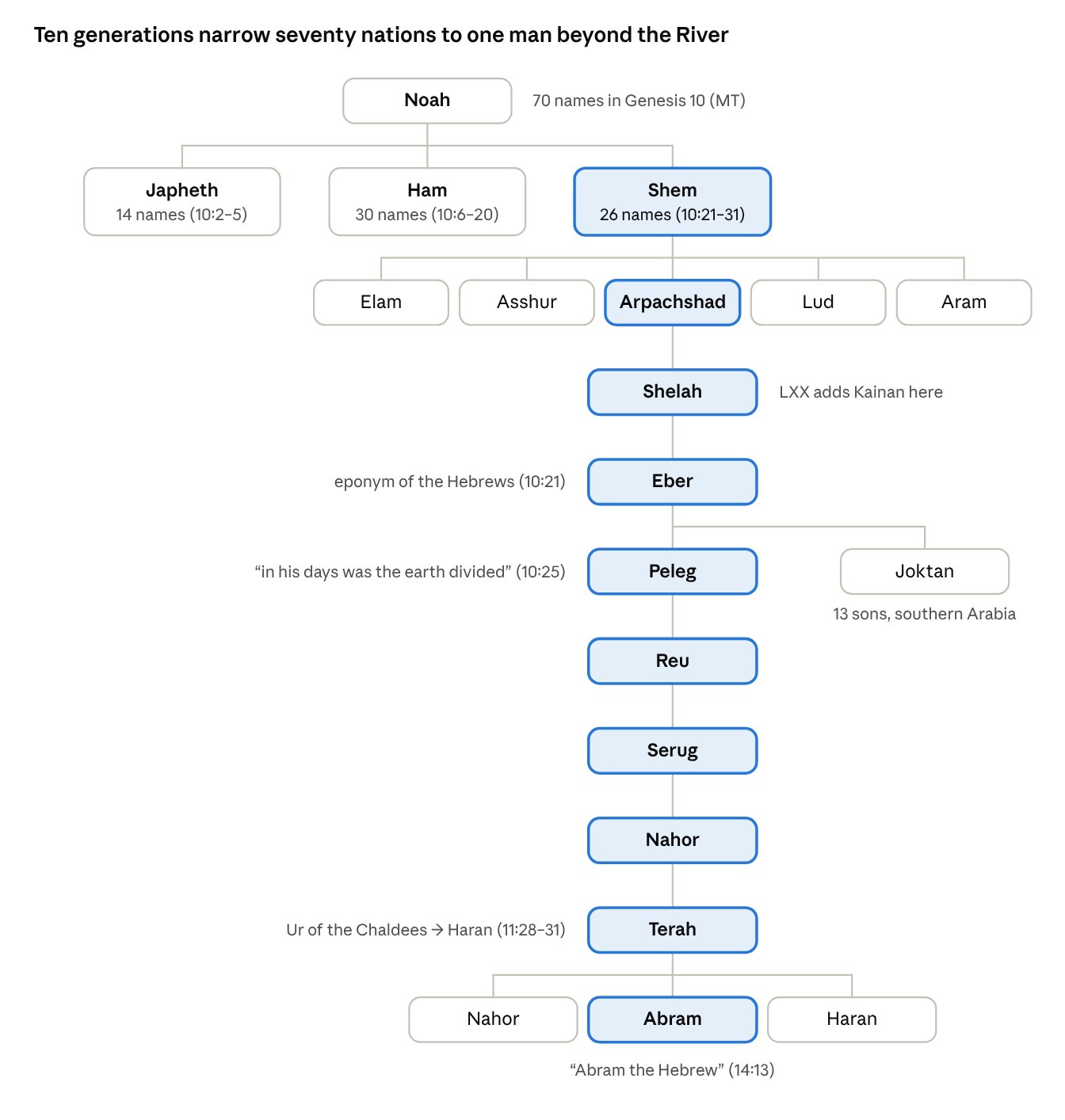
The highlighted line runs from Shem through Arpachshad, Eber, and Peleg to Terah and Abram; the other branches end in the nations of Genesis 10.
Names and Places in Upper Mesopotamia
Several names in Terah’s ancestry match place names in the Haran region in cuneiform sources: Serug with Sarugi, Nahor with Nahur, and Terah with Til-Turahi. These matches place the family’s memory in upper Mesopotamia, the region of Haran, east of the Euphrates.
The House of Terah (11:27–30)
Terah begets Abram, Nahor, and Haran (11:27). Haran dies “before his father Terah in the land of his nativity, in Ur of the Chaldees” (11:28). Later midrash expands his death into a story of Nimrod’s furnace (Genesis Rabbah 38:13), linking Terah’s house to Nimrod’s kingdom; this is derash, not peshat.
Nahor marries Milcah. “But Sarai was barren; she had no child” (11:30). The line that Genesis 10–11 has followed from Shem appears to end here, just before the promise of seed.
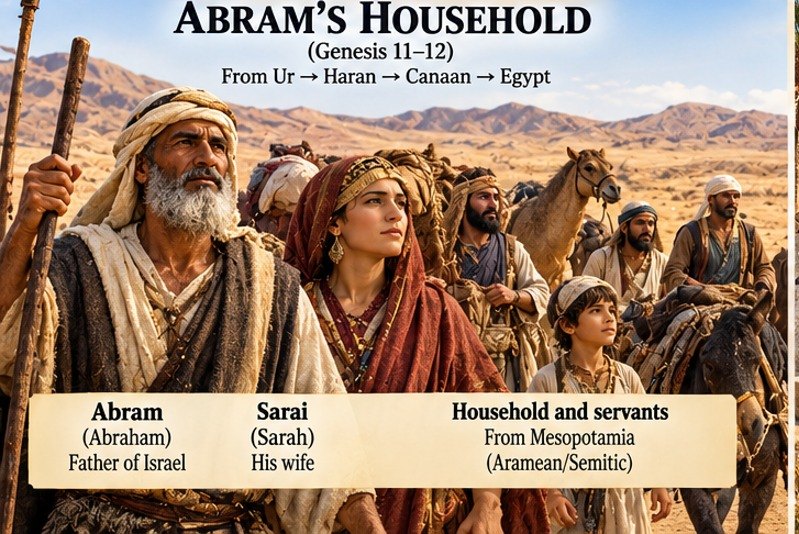
The Journey That Stopped (11:31–32)
“And Terah took Abram his son … and they went forth with them from Ur of the Chaldees, to go into the land of Canaan; and they came unto Haran, and dwelt there” (11:31).
Terah began the journey toward Canaan but did not complete it. Haran lies on the Balikh river in upper Mesopotamia, east of the Euphrates. Terah settles on the eastern side and dies there at 205 (11:32).
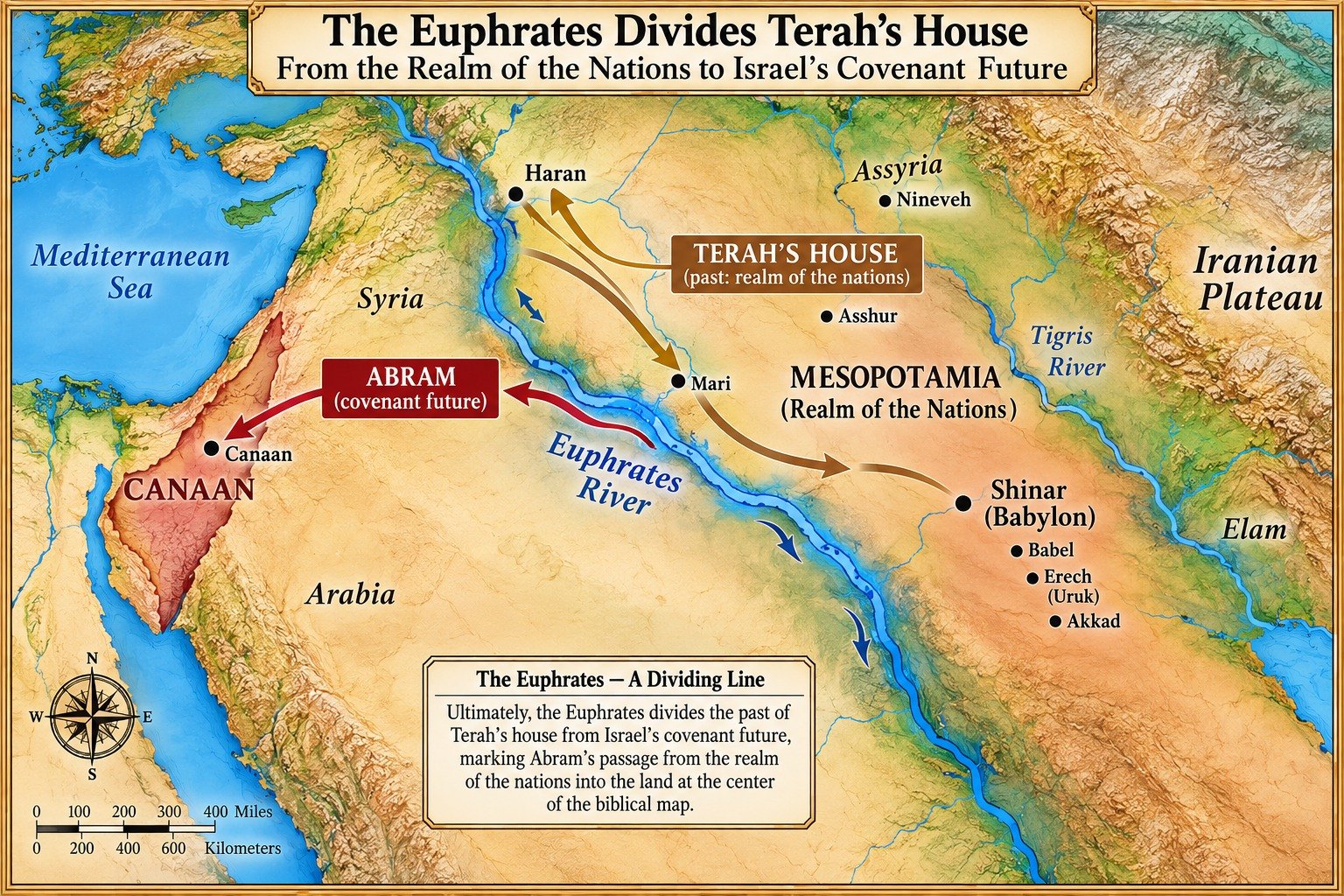
Terah’s journey ends at Haran, still east of the Euphrates. Abram’s route crosses the River and enters the land at Shechem.
The Order of Terah’s Death and Abram’s Departure
If Terah was 70 at Abram’s birth (11:26) and Abram left Haran at 75 (12:4), Terah was alive for sixty more years. The Torah nonetheless reports Terah’s death (11:32) before Abram’s call (12:1).
- Rashi on 11:32 explains that the Torah records the death first so that Abram’s leaving his aged father would not be publicized.
- Stephen says Abram moved from Haran “when his father was dead” (Acts 7:4), following the narrative order.
- Some interpreters read 11:26 as naming Abram first for importance, not birth order, which removes the difficulty.
The Call: From Ur or From Haran?
The call of 12:1 is heard in Haran: “Get thee out of thy country, and from thy kindred, and from thy father’s house.” Other texts locate its origin in Ur:
- “I am the LORD that brought thee out of Ur of the Chaldees” (Gen 15:7).
- “Thou … didst choose Abram, and broughtest him forth out of Ur of the Chaldees” (Neh 9:7).
- God appeared to Abraham “when he was in Mesopotamia, before he dwelt in Charran” (Acts 7:2).
Genesis 15:7 uses exodus language: “brought thee out” (hôṣēʾtîkā) echoes “which have brought thee out of the land of Egypt” (Exod 20:2). Abram’s departure from Mesopotamia is the first exodus.
Israel at the Center of the Earth
The nations of Genesis 10 are arranged around a center, and Scripture and Jewish tradition locate that center in the land of Israel, in Jerusalem, and in Zion. The theme runs from the peshat of the prophets, through the Septuagint and Second Temple writers, to the rabbis.
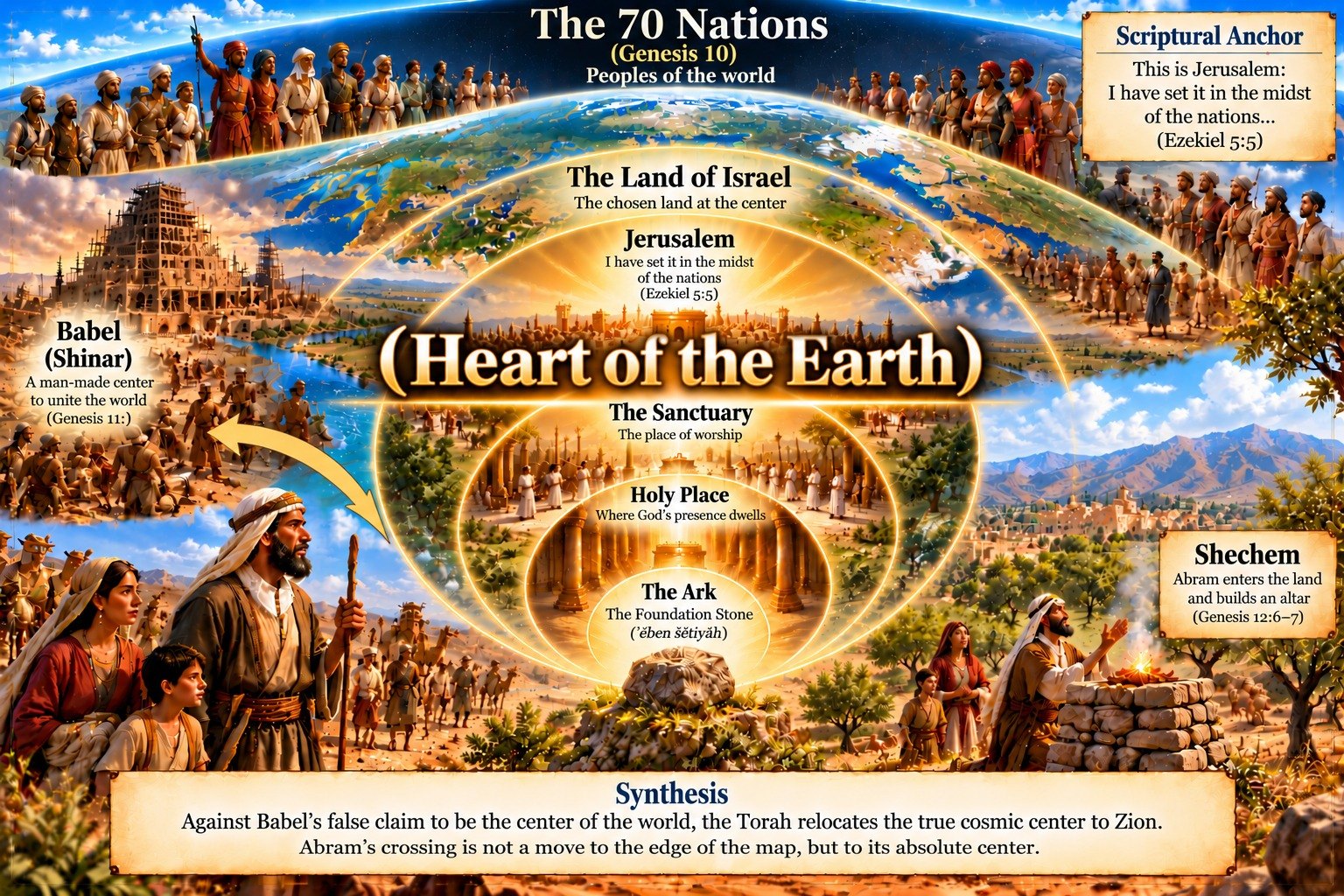
The Peshat: “In the Midst of the Nations”
- Ezekiel 5:5. “This is Jerusalem: I have set it in the midst (bĕtôk) of the nations and countries that are round about her.” The LORD himself places the city at the center.
- Ezekiel 38:12. Gog comes against the people “that dwell in the midst of the land,” literally “on the ṭabbûr of the earth.”
- Judges 9:37. The same phrase, ṭabbûr hā-ʾāreṣ, names the heights at Shechem, where Abram built his first altar in the land (Gen 12:6–7).
- Deuteronomy 32:8 (MT). The Most High set the bounds of the peoples “according to the number of the children of Israel.” On this reading, the map of the nations is drawn with Israel as its reference point.
- Genesis 10. The Table moves from the far peoples of Japheth, through Ham, to Shem, and the only border it traces is the land of Canaan (10:19). The chapter’s map is oriented toward that land.
The Historical and Ancient Near Eastern Setting
The idea of a sacred center was common in the ancient Near East and the Mediterranean world:
- Babylon. The Babylonian Map of the World (British Museum, c. 6th century BCE) places Babylon on the Euphrates at the center of the world, ringed by the cosmic “bitter river.”
- Nippur. Its temple complex was called Dur-an-ki, “bond of heaven and earth.”
- Delphi. The Greeks marked the omphalos, the navel of the world, at Delphi.
Against this background, Genesis 11 is a polemic. Babel claims to be the gate of heaven and the center of the world, and the Torah calls it confusion and scatters its builders. The center is relocated from Babylon to the land the LORD gives to Abram.
The philology of ṭabbûr is debated. Later Hebrew uses it for “navel,” but Shemaryahu Talmon and others argue that in Ezekiel 38:12 and Judges 9:37 it means an elevated height or plateau. Even on that reading, Ezekiel 5:5 states the center plainly.
Second Temple Witnesses
- The Septuagint. Ezekiel 38:12 and Judges 9:37 render ṭabbûr as omphalos tēs gēs, “the navel of the earth.” Alexandrian Jewish translators read Israel’s land as the world’s navel.
- 1 Enoch 26:1. Enoch is brought to “the middle of the earth,” a blessed place of mountains and streams, describing Jerusalem and its valleys.
- Letter of Aristeas 83–84. Jerusalem stands on a mountain in the middle of Judea, with the Temple at its summit.
- Josephus, War 3.52. Jerusalem lies in the middle of Judea, and some call it the navel (omphalos) of the country.
- Jubilees 8:12, 19. Mount Zion is “the center of the navel of the earth.” Jubilees is cited here only for the center motif, not for its allotment of territory; it is a second-century BCE work with a sectarian setting.
Rabbinic Testimony
- Tanhuma, Kedoshim 10. As the navel is set in the middle of a person, so the land of Israel is the navel of the world. Jerusalem is at the center of the land, the Sanctuary at the center of Jerusalem, the Holy Place at the center of the Sanctuary, the ark at the center of the Holy Place, and before the ark the foundation stone, from which the world was founded.
- b. Yoma 54b. The world was created from Zion, beginning with the ʾĕben šĕtîyāh, the foundation stone.
- b. Sanhedrin 37a. The Sanhedrin sat in “the navel of the world.”
- b. Kiddushin 69a. The Temple is higher than all the land of Israel, and the land of Israel is higher than all lands.
- m. Kelim 1:6–9. Ten degrees of holiness rise in concentric order: the land of Israel above all lands, Jerusalem above the land, the Temple Mount, and inward to the Holy of Holies.
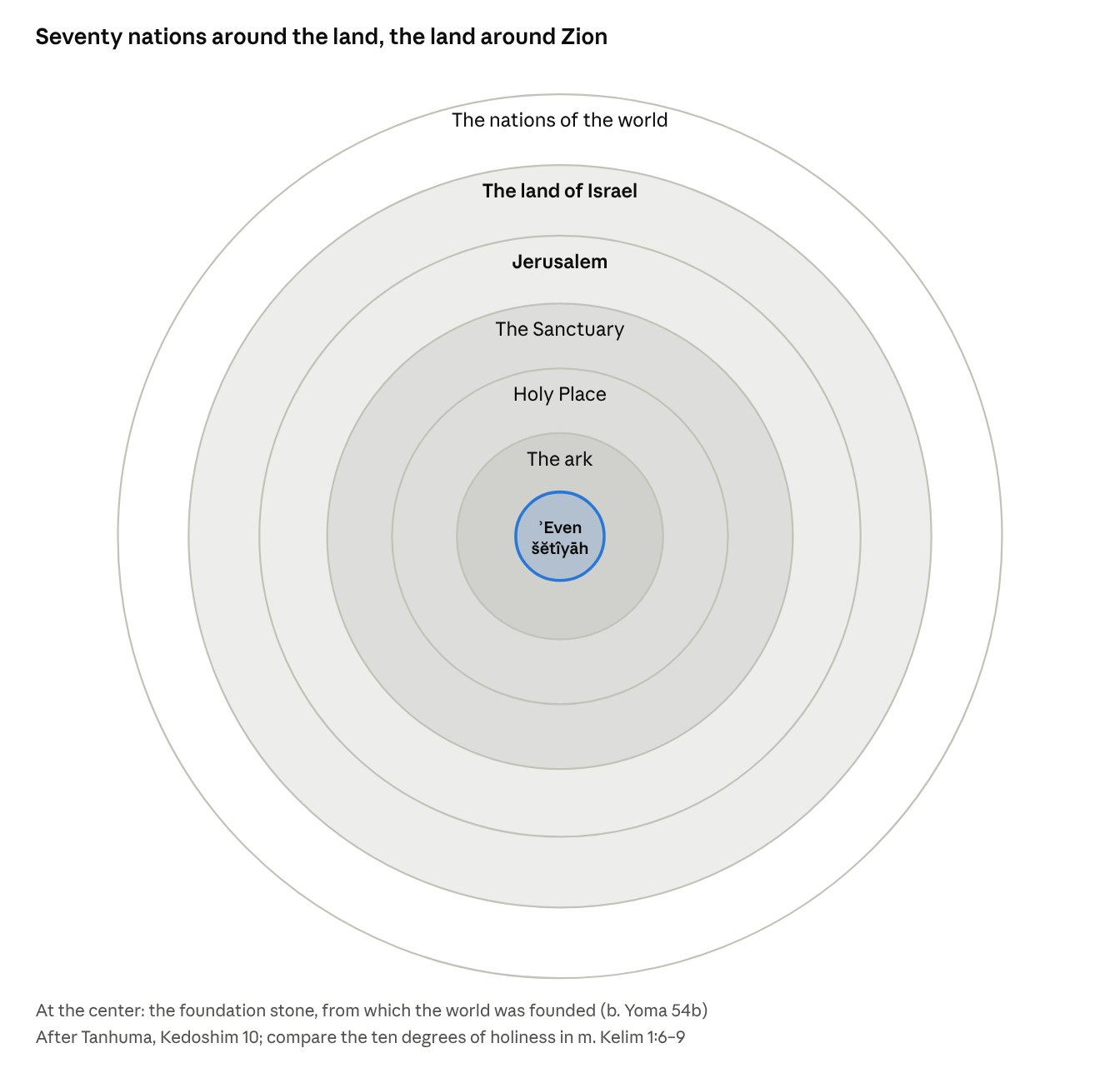
Each ring sits inside the next, from the nations of the world inward to the foundation stone before the ark.
Significance for Genesis 10–11
The seventy nations are arranged around the land, and the land around Zion. Abram’s crossing is not a move to the edge of the map but to its center. The heir of Eber leaves Babel’s claimed center and enters the place the LORD names as the midst of the nations.
The River and the Crossing
The Euphrates is “the River” (hannāhār), and the Torah uses it to mark both where Israel’s fathers came from and how far Israel’s inheritance reaches. Abram’s identity as the ʿIvri is defined by crossing it.
“Abram the Hebrew” (Gen 14:13)
Genesis 14:13 is the first place the word ʿIvri appears: “there came one that had escaped, and told Abram the Hebrew.” Ancient Jewish interpretation reads the name in three ways:
- Genealogical. Abram descends from Eber (10:21, 24–25; 11:14–26).
- Geographical. The Septuagint renders the phrase Abram tō peratē, “Abram the one who crossed over.” Philo explains that “Hebrew” means “one who passes over” (De migratione Abrahami 20).
- Religious. Genesis Rabbah 42:8 records three views. R. Nehemiah derives the name from Eber; the Rabbis from his coming from the other side of the River. R. Judah reads it as a stance: the whole world stood on one side (ʿēver) and Abram on the other.
The three readings do not compete. Abram is Eber’s heir, he came from beyond the River, and he stood apart from the gods worshipped there.
“Beyond the River” Depends on Where One Stands
The phrase ʿēver hannāhār is relative to the speaker:
- From Shechem in Canaan, Joshua says the fathers dwelt “beyond the River,” meaning east of the Euphrates (Josh 24:2).
- From the Persian court, the province west of the Euphrates is called “Beyond the River” (Ezra 4:10, 17; 8:36; Neh 2:7).
- In Solomon’s reign, the kingdom ruled “all the region on this side the river” (1 Kgs 5:4; Eng. 4:24).
The Torah’s perspective is from the land. Abram is “from the other side” because Genesis speaks from Canaan, the center.
The First Crossing (Gen 12:4–6)
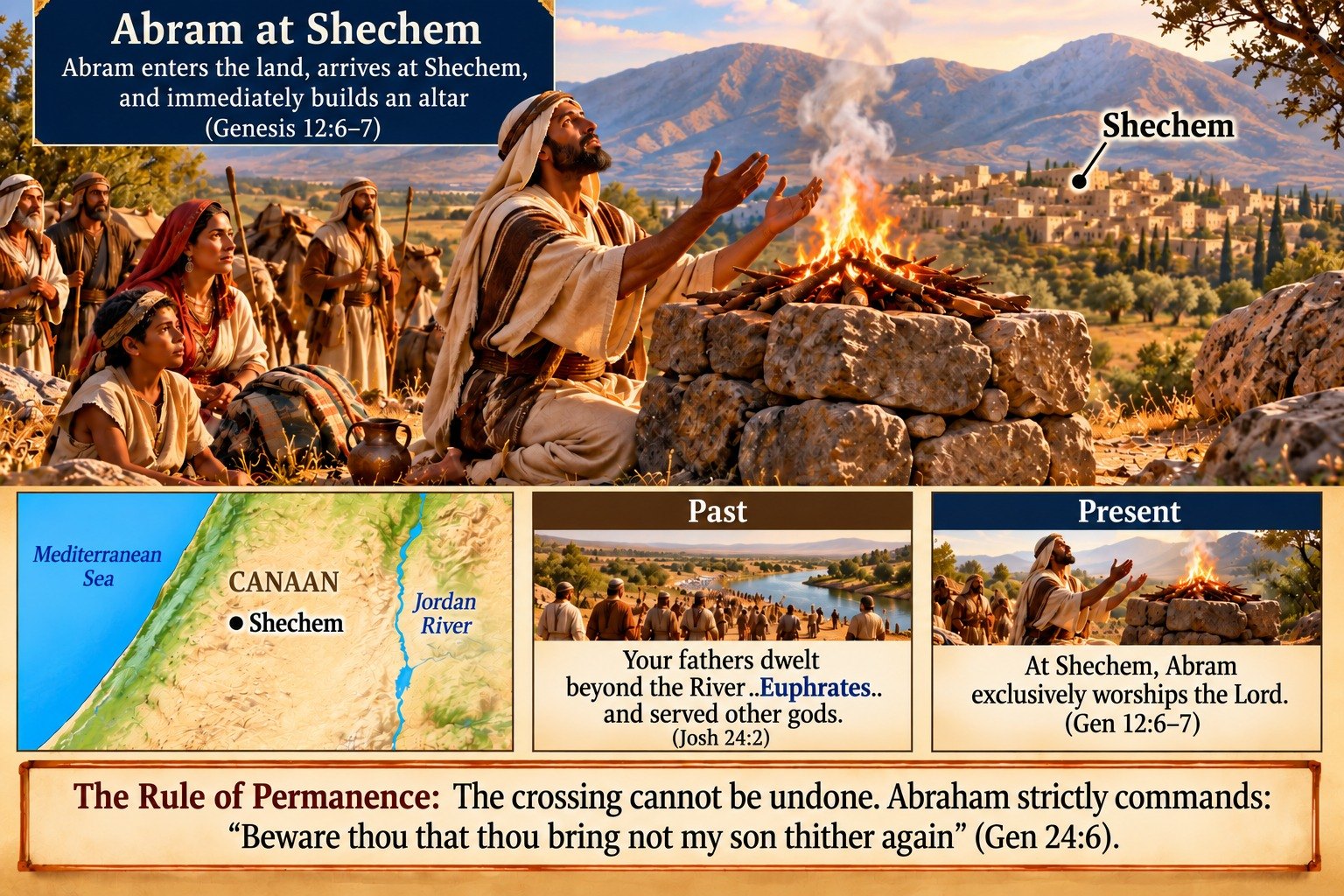
Abram leaves Haran at 75 with Sarai, Lot, and their household, “and into the land of Canaan they came” (12:5). Then “Abram passed through (way-yaʿaḇōr) the land unto the place of Shechem” (12:6). The root ʿbr appears at the moment he enters the land.
At Shechem the LORD appears and promises, “Unto thy seed will I give this land,” and Abram builds an altar (12:7). The first act in the land is worship of the LORD, in contrast to the gods beyond the River.
The Euphrates as the Boundary of the Promise (Gen 15:18)
“In the same day the LORD made a covenant with Abram, saying, Unto thy seed have I given this land, from the river of Egypt unto the great river, the river Euphrates” (15:18).
The River Abram crossed becomes the outer limit of what his seed inherits. The Torah repeats the boundary (Exod 23:31; Deut 1:7; 11:24; Josh 1:4), and Solomon’s rule reaches it (1 Kgs 5:1; Eng. 4:21). The Euphrates thus marks both the departure and the boundary of the promise.
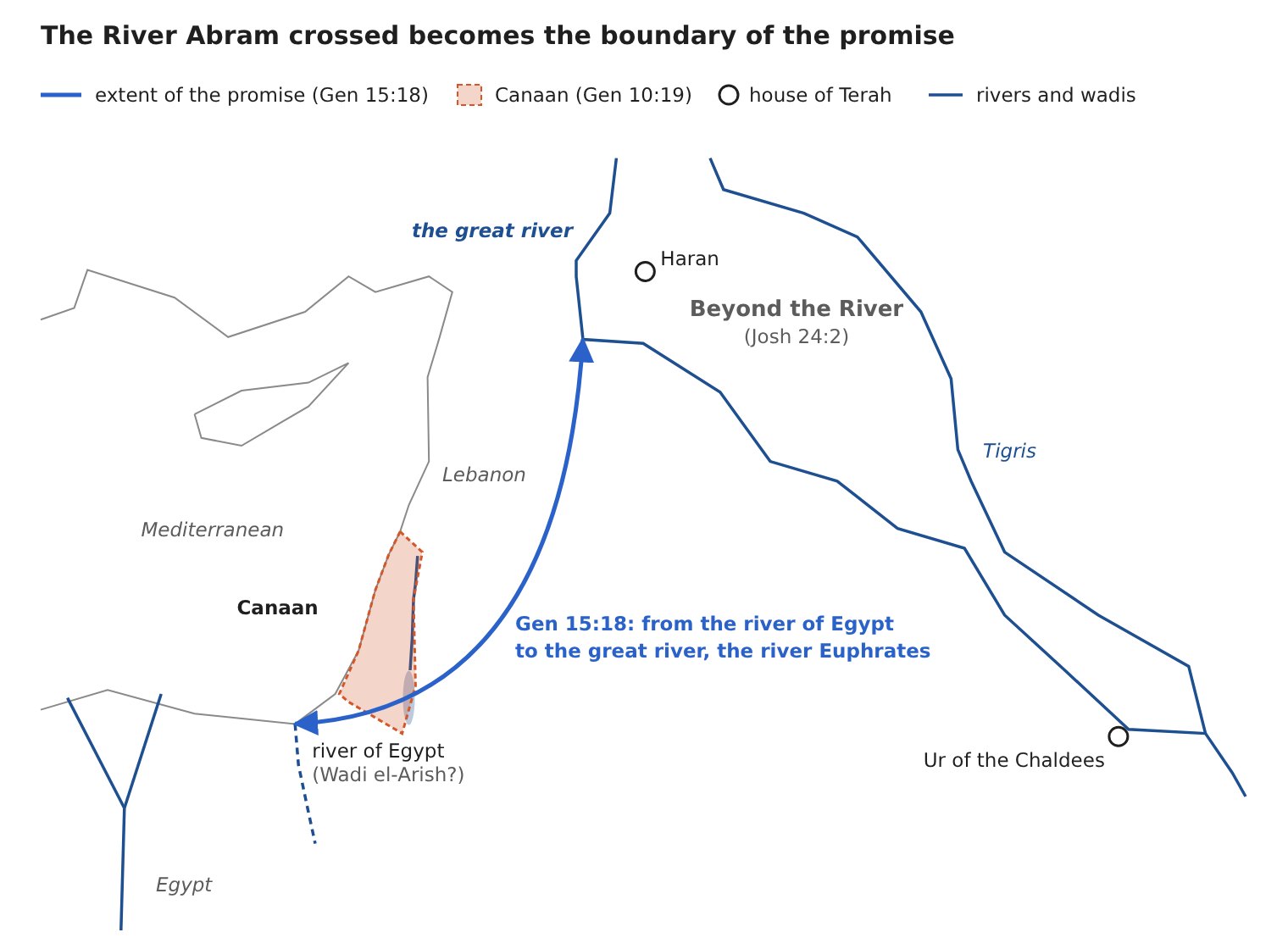
The arrow marks the two endpoints the Torah names, not a surveyed border. The identification of “the river of Egypt” is debated: many take it as the Wadi el-Arish, others as a branch of the Nile.
No Return for the Heir (Gen 24)
When Abraham seeks a wife for Isaac, he sends his servant to Aram-naharaim, “unto the city of Nahor” (24:10). Nahor’s branch of Terah’s house has stayed east of the River. Abraham forbids Isaac to go back: “Beware thou that thou bring not my son thither again” (24:6, 8). The crossing is not to be undone by the heir.
Jacob Crosses Again (Gen 31–32)
Jacob flees to Haran (28:10), and twenty years later he “rose up, and passed over (way-yaʿaḇōr) the river” (31:21). He repeats Abram’s crossing westward.
At Gilead, Laban and Jacob set up a heap of stones as a boundary: “I will not pass over this heap to thee, and … thou shalt not pass over this heap and this pillar unto me” (31:52). Laban names it in Aramaic, Yĕgar Śāhădûtāʾ, and Jacob in Hebrew, Galʿēd (31:47). Here the categories of Genesis 10 — family, language, and land — separate Aram from Israel at a covenanted border.
Jacob then says, “with my staff I passed over (ʿāḇartî) this Jordan” (32:10), and crosses the ford of the Jabbok (maʿaḇar, 32:22).
Israel’s Confession (Deut 26:5)
At the offering of firstfruits, every Israelite declares, “A wandering Aramean (ʾArămmî ʾōḇēd) was my father” (Deut 26:5). The confession remembers origins east of the River, then recounts the descent into Egypt, the exodus, and the gift of the land.
The Covenant at Shechem (Josh 24)
“The Flood” in Joshua 24 Means the Euphrates
Christian readers familiar with the King James Version may mistake “the flood” in Joshua 24:2–3, 14–15 for Noah’s flood. In these verses, however, “the flood” translates the Hebrew hannāhār, “the River,” the Bible’s customary designation for the Euphrates. Modern translations therefore render the phrase “beyond the River” or “beyond the Euphrates.” Joshua is describing the ancestral homeland of Terah and Abraham in Mesopotamia, not the antediluvian world.
The expression occurs four times in Joshua’s address. The fathers, including Terah, lived “beyond the River” (24:2); the LORD took Abraham from “beyond the River” and led him through Canaan (24:3); Israel must put away the gods served “beyond the River” and in Egypt (24:14); and the people must choose between the LORD and the gods served “beyond the River” or in Canaan (24:15). The repeated phrase joins geography and worship: the Euphrates marks the land from which Abraham was taken and the foreign gods Israel must reject.
Joshua gathers Israel at Shechem, where Abram first built an altar, and the LORD speaks: “Your fathers dwelt on the other side of the flood (bĕʿēver hannāhār) in old time, even Terah … and they served other gods. And I took your father Abraham from the other side of the flood, and led him throughout all the land of Canaan” (24:2–3).
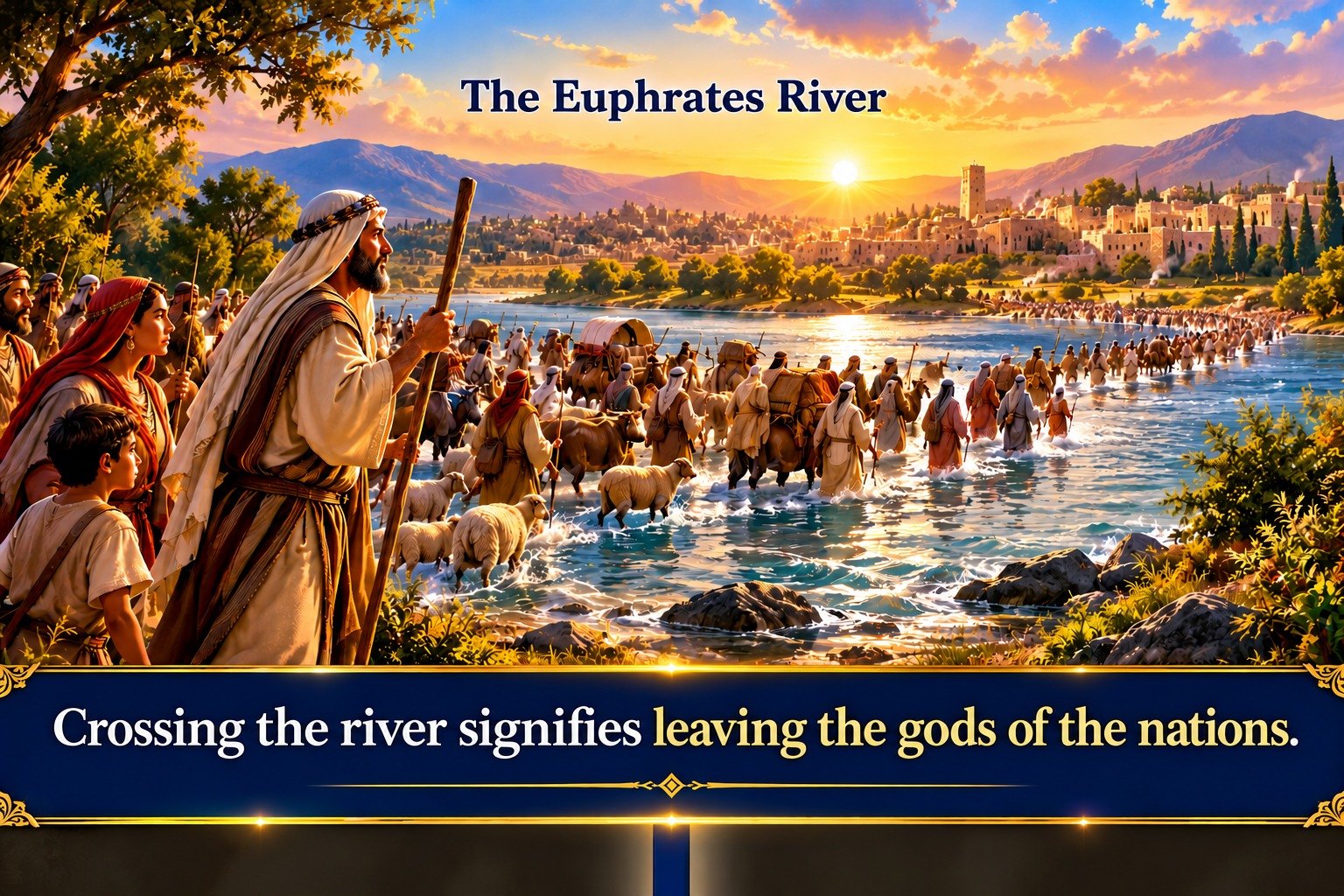
Joshua then sets the choice: put away “the gods which your fathers served on the other side of the flood,” that is, beyond the Euphrates, “and in Egypt,” and serve the LORD (24:14–15). The geographical crossing carries a religious meaning. Beyond the River lay the gods allotted to the nations (Deut 4:19); within the land, Israel serves the LORD whose portion it is (Deut 32:9).
The Ancestral Homeland: Sources and Locations
That Abram’s family lived beyond the Euphrates rests on the primary texts, not on modern summaries. This section sets out those texts, the identification of Ur and Haran, and what the evidence can and cannot settle.
The Primary Witnesses
| Source | Date | What it says |
|---|---|---|
| Genesis 11:28, 31 | Torah | Haran dies in Ur of the Chaldees; Terah leaves Ur for Canaan and settles in Haran |
| Genesis 15:7 | Torah | the LORD brought Abram out of Ur of the Chaldees |
| Joshua 24:2–3 | Former Prophets | the fathers dwelt beyond the River and served other gods; the LORD took Abraham from there |
| Nehemiah 9:7 | post-exilic | God chose Abram and brought him out of Ur of the Chaldees |
| Septuagint Genesis 11:28, 31 | 3rd c. BCE | renders Ur of the Chaldees as “the land (chōra) of the Chaldeans” |
| Josephus, Antiquities 1.151–152 | 1st c. CE | Haran died among the Chaldeans in Ur, where his tomb was shown; the family then moved to Haran in Mesopotamia |
Joshua 24:2–3 carries the argument by itself: from the land, the LORD says the fathers were beyond the River.
Where Was Ur of the Chaldees?
| Proposal | Location | For | Against |
|---|---|---|---|
| Southern Ur | Tell el-Muqayyar, southern Iraq; excavated by Leonard Woolley, 1922–1934 | the major city named Ur; Chaldean tribes settled in southern Babylonia; a center of the moon god | far from Haran and from the family’s later ties in upper Mesopotamia |
| Northern Ur | Şanlıurfa (Edessa) tradition, or a town “Ura” (Cyrus Gordon) | close to Haran; matches the Haran-region family names (Serug, Nahor, Terah) | the Chaldeans are attested in the south, not the north |
Either location lies in Mesopotamia. From Canaan, both are “beyond the River,” which is all Joshua 24:2 requires.
The ancient course of the Euphrates near southern Ur differs from the modern one, so the exact bank on which the city stood is uncertain. The commentary does not rest on that point. It rests on the Torah’s own perspective, which places the fathers beyond the River.
The Septuagint’s “land of the Chaldeans” reads ʾûr as a region rather than a city. On that reading, Terah’s homeland is Chaldea in general.
Haran
Haran (Harran) lies on the Balikh river in upper Mesopotamia, in present-day southeastern Turkey, east of the Euphrates. Both Ur and Haran were major centers of the moon god (Sumerian Nanna, Akkadian Sin).
This gives concrete content to Joshua 24:2, “they served other gods,” and to Deuteronomy 4:19, which names the sun, the moon, and the stars as the host allotted to the nations. Terah’s house lived in the two great cities of the moon. Laban’s household gods (tĕrāpîm, Gen 31:19) show that this worship continued in Nahor’s branch.
Arpachshad’s Territory
The Hebrew Bible names no land for Arpachshad. The eastern location argued above rests on Arrapha, on the Kasdim association, and on Josephus. It is a historical-geographic inference and is presented as one.
Conclusion
Genesis 10 maps the world as seventy nations, each with its family, language, land, and political order, apportioned under the host of heaven. Genesis 11 explains how that map was drawn at Babel and then narrows it to one family in Ur of the Chaldees and Haran.
The Euphrates divides that family’s past from its future. Beyond the River, Terah’s house lived among the gods allotted to the nations, in the cities of the moon. Abram the ʿIvri crossed the River, passed through the land to Shechem, and received the promise of a land bounded by the very river he had crossed.
The nations are arranged around the land, and the land around Zion. Abram does not cross from the center to the margin but from Babel’s claimed center to the place the LORD sets “in the midst of the nations” (Ezek 5:5). Isaac does not go back, Jacob crosses again, and Israel at Shechem chooses the LORD over the gods beyond the River. “For the LORD’s portion is his people; Jacob is the lot of his inheritance” (Deut 32:9).


Your voice matters. Iron sharpens iron. What insights or questions do you bring to the table?