
Why “I will lift up mine eyes unto the hills” became a comforting platitude—and what the Hebrew text actually means
Introduction
Psalm 121:1 is one of the most beloved and frequently quoted lines in the Bible: “I will lift up mine eyes unto the hills, from whence cometh my help.” For many Christian readers, the verse has become a comforting statement about looking to the hills as a symbol of divine help. Yet this familiar reading misses the force of the Hebrew text. The psalmist is not declaring that help comes from the hills; he is asking a question: “From where will my help come?” Verse 2 gives the answer: “My help comes from the LORD, the Maker of heaven and earth.” This paper argues that the misunderstanding of Psalm 121:1 comes from several overlapping factors: the older English wording of the King James Version, the loss of the question in English reception, the failure to read the verse within the meaning of “A Song of Degrees,” and the neglect of Psalm 121’s pilgrimage setting. When read in context, the psalm does not direct trust toward the hills themselves. It directs the worshiper beyond the visible landscape to the LORD alone.
The argument unfolds in four movements. First, it shows that Psalm 121:1 is a question, not a declaration that help comes from the hills. Second, it explains why the title “A Song of Ascents” places the psalm in the setting of pilgrimage and worship. Third, it distinguishes Zion, the surrounding hills, and the high places that Scripture often associates with misplaced trust. Finally, it explains how the KJV wording helped the verse become a familiar devotional platitude and why recovering the question restores the psalm’s theological force.
The Text and the Common Reading
The King James wording has shaped generations of Christian memory because its cadence is beautiful and its phrasing sounds complete. Many readers hear the verse as a simple declaration: the believer lifts the eyes to the hills, and help comes from there. That is why the line appears so often on plaques, mugs, sermons, songs, scenic photographs, retreat-center signs, and devotional posts. The problem is not that Christians love the verse. The problem is that the familiar wording has often made the hills sound like the source or channel of divine help, when verse 2 identifies the LORD as the source.
Psalm 121:1 in the KJV reads: “I will lift up mine eyes unto the hills, from whence cometh my help.”
The Hebrew text contains the expression מֵאַיִן יָבֹא עֶזְרִי (me’ayin yavo ezri), which means “From where will my help come?” The key term is me’ayin (“from where?”), an interrogative expression that asks about source or origin. Although ancient Hebrew manuscripts do not use modern question marks, the wording itself marks the clause as a question.
The Septuagint, the ancient Greek translation of the Hebrew Scriptures, confirms this reading. In the Greek text, Psalm 121 is numbered as Psalm 120, and verse 1 reads: pothen hexei he boetheia mou—“From where will my help come?” The Greek word pothen means “from where?” and plainly preserves the question already present in the Hebrew. This shows that the ancient Greek translators did not understand the hills as the source of help; they understood the line as a question answered by verse 2.
What “A Song of Degrees” Means
The heading “A Song of Degrees” is the King James rendering of the Hebrew superscription שִׁיר לַמַּעֲלוֹת (shir la-ma‘alot), more commonly translated today as “A Song of Ascents.” The Hebrew term ma‘alot comes from a root associated with going up, rising, steps, or ascent. The older English word “degrees” can suggest stages, steps, or upward movement, but for many modern readers it no longer communicates the meaning clearly. “Ascents” is therefore a more transparent rendering because it immediately suggests movement upward—geographically, liturgically, and spiritually.
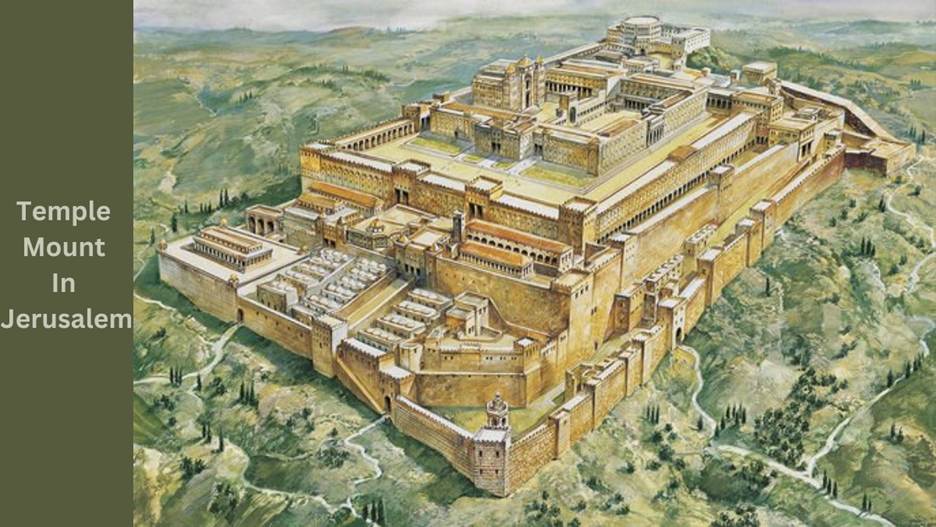
This matters for Psalm 121 because the title places the psalm within the fifteen Songs of Ascents, Psalm 120 through Psalm 134. These psalms are traditionally associated with Israel’s movement toward worship. The ascent may refer to pilgrims traveling up to Jerusalem for the major festivals, since Jerusalem sits in the hill country and worshipers literally went up to Zion. It may also refer to liturgical ascent within the temple precincts, where later Jewish tradition connected the fifteen Songs of Ascents with steps in the temple. In both senses, the heading frames Psalm 121 as a worshiper’s travel song: it belongs to the road, the climb, the anxiety, and the hope of approaching the place of worship.
Later Jewish tradition also connected the fifteen “Songs of Ascents” with fifteen steps in the Temple. The Mishnah (an authoritative Jewish legal text compiled after the destruction of the Second Temple) describes the Levites (Temple servants from the tribe of Levi) standing with musical instruments on fifteen steps between the Court of Israel and the Court of Women during a special festival celebration. These steps corresponded to the fifteen Songs of Ascents in Psalms 120–134. This tradition does not replace the pilgrimage meaning of “ascent,” but it reinforces the larger idea that these psalms were remembered in connection with upward movement toward worship.
The title “A Song of Degrees” identifies Psalm 121 as part of Israel’s tradition of ascent toward worship. The psalmist is not casually admiring mountains. He is participating in a tradition of ascent, where hills, roads, danger, temple longing, and trust in God all meet. The heading prepares the reader to hear verse 1 as the voice of a pilgrim literally making aliyah (going up, or ascending) to the Temple—ascending toward the heights while asking the decisive question: “From where will my help come?”
The Septuagint also supports this ascent setting by rendering the title as ode ton anabathmon, “A Song of Ascents” or “A Song of the Steps.” The Greek term points to upward movement, steps, or ascent, which fits both the pilgrimage journey up to Jerusalem and the later Temple-step tradition remembered in Jewish sources.
Psalm 121 as a Pilgrim Song
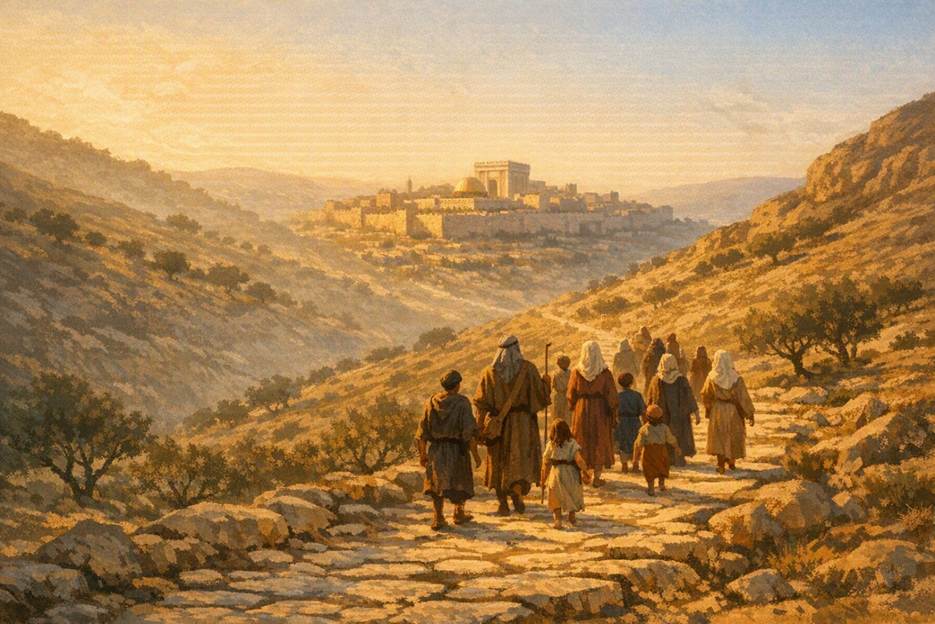
Psalm 121 is not an abstract nature poem. It is a travel psalm, a worship psalm, and a theology of protection. As a pilgrim song, it belongs to the road toward Jerusalem, where the worshiper sees hills, terrain, danger, and the approach to Zion. The hills may include the surrounding elevations of Jerusalem, the difficult landscape of the journey, and, by broader biblical association, the high places that competed for Israel’s trust. In every case, the psalm redirects the worshiper from visible elevation to divine preservation.
The pilgrim sees the hills and confronts a real question: Where is help found on this dangerous and sacred road? The answer is not in the landscape itself, but in the LORD who “will neither slumber nor sleep,” who keeps Israel, and who guards one’s going out and coming in.
The Problem with the KJV Reading
The King James Version is not useless here; its language is dignified, memorable, and historically influential. Still, Psalm 121:1 shows why readers should not rely on the KJV alone when older English, Hebrew grammar, and historical context are all in play. The first issue is punctuation. The KJV prints the line as a statement: “I will lift up mine eyes unto the hills, from whence cometh my help.” But the Hebrew clause מֵאַיִן יָבֹא עֶזְרִי contains the interrogative expression me’ayin, meaning “from where?” The clause therefore reads most naturally as a question: “From where will my help come?”
The second limitation is the phrase “from whence.” In early modern English, “whence” already means “from where,” but many modern readers no longer hear it that way. They tend to read “from whence cometh my help” as if it means “from the hills, where my help comes from.” In other words, the KJV’s older English form unintentionally encourages a modern misreading. The problem is not that the KJV intended to teach that help comes from the hills; the problem is that its wording allows that impression when the verse is isolated from verse 2.
The third limitation is that the KJV’s verse division and familiar devotional quotation can make the first verse sound self-contained. But Psalm 121:1 is not complete without Psalm 121:2. Verse 1 asks the question; verse 2 gives the answer: “My help cometh from the LORD, which made heaven and earth.” The theological center of the psalm is not the hills but the LORD. The KJV preserves the beauty of the passage, but interpretation must recover the question-and-answer movement that the Hebrew text makes plain.
The Septuagint makes the KJV problem even clearer. Its Greek wording preserves the same question found in the Hebrew: “From where will my help come?” Because the LXX stands as an ancient translation witness, it shows that the question was not a modern correction imposed on the psalm. The question belongs to the older textual tradition itself; what became unclear was the later English reception of the KJV wording.
Why the Hebrew Text Should Govern the English Reading
For that reason, the KJV should be handled as a historically important translation, not as the final authority on the verse’s meaning. The Hebrew text is not ambiguous: it plainly asks, “From where will my help come?” The ambiguity belongs to the English reception of the verse, where older phrasing and punctuation have allowed modern readers to hear a question as though it were a statement. A responsible reading must therefore let the Hebrew text clarify what the English wording has obscured: the psalmist is not declaring that help comes from the hills; he is asking where help truly comes from.
Zion, the Surrounding Hills, and the Source of Help
Psalm 121 does not teach that help comes from “the hills” in a general or mystical sense. Help comes from the LORD, the covenant God of Israel and the Creator of heaven and earth. At the same time, the pilgrimage setting matters. The worshiper is ascending toward Zion—the Temple Mount, the holy hill associated with God’s presence and covenant worship. The destination is sacred, but the source of help is still the LORD.
Therefore, the help comes from the LORD, while the pilgrimage is oriented toward Zion, not toward “the hills” generically. The hills are part of the pilgrim’s visible landscape, but they are not the source of the pilgrim’s security.
This distinction is important because Scripture often contrasts Zion, the LORD’s holy hill, with other hills and high places that became centers of misplaced trust, unauthorized worship, and idolatry. A “high place” refers to an elevated worship site, often located on a hill or mountain, where sacrifice or religious devotion took place outside the worship God authorized.
- 1 Kings 14:23 says Judah built high places “on every high hill and under every green tree,” showing that hills could become rival worship locations rather than places of covenant faithfulness.
- 2 Kings 17:9–11 says Israel built high places and burned incense on them, directly connecting elevated worship sites with religious corruption.
- Jeremiah 3:6 describes Israel going “upon every high mountain and under every green tree” in spiritual unfaithfulness, using mountain and hill imagery as the language of covenant betrayal.
- Ezekiel 6:3–6 addresses the “mountains of Israel” and condemns the high places, altars, and idols located there, making the hills themselves witnesses against rival worship.
- Hosea 4:13 says the people sacrifice on mountaintops and burn offerings on hills because the place is attractive, but the prophet treats this as unfaithfulness rather than devotion.
- Psalm 48:1–2, by contrast, calls Zion “the mountain of his holiness,” identifying Zion as the holy mountain connected to God’s presence.
- Psalm 2:6 declares that God has set his king upon “my holy hill of Zion,” singling out Zion as the hill of divine rule.
These examples show a consistent biblical pattern: Zion is the hill of divine presence, covenant worship, and God’s rule, while other hills and high places can represent rival religious claims that Israel was commanded to reject.
For Psalm 121, however, the point must be stated carefully. The “hills” are not necessarily distant pagan mountains somewhere else. In the pilgrimage context, they most naturally include the hills surrounding Jerusalem and the ascent toward Zion. The worshiper is going up to Jerusalem, so the visible landscape is filled with surrounding elevations. Zion is the central holy hill, but it stands in contrast to every other elevation that might be mistaken for the source of help.
The issue, then, is not a simplistic contrast between “bad pagan hills over there” and “good Zion hill over here.” The interpretation is more nuanced: the pilgrim lifts his eyes to the hills surrounding Jerusalem and the approach to Zion, but even those hills are not the source of help. They are part of the sacred geography of ascent, yet they must not be confused with the LORD himself.
The question in Psalm 121:1 may therefore be heard against the background of Israel’s recurring temptation to seek help from the surrounding hills and high places—elevated worship sites often associated with Canaanite worship, unauthorized sacrifice, and misplaced trust. The pilgrim sees the hills on the way to Zion, but the question refuses to let those hills become the answer. Verse 2 gives the theological correction: “My help comes from the LORD, the Maker of heaven and earth.” This confession stands against every false source of security, whether the visible hills, the high places of unauthorized worship, or the expectation that sacred geography itself can save.
Jeremiah 3:23 gives this point its clearest prophetic expression. Psalm 121 asks, “From where will my help come?” and answers, “My help comes from the LORD, the Maker of heaven and earth.” Jeremiah states the same theology more sharply: “Truly in vain is salvation hoped for from the hills, and from the multitude of mountains: truly in the LORD our God is the salvation of Israel.” Read together, the two passages show that hills and mountains may be visible, impressive, and religiously suggestive, but they are not the source of salvation. Psalm 121 turns the pilgrim’s gaze beyond the hills to the LORD who created them, while Jeremiah warns Israel not to place hope in hills or high places. Both texts therefore agree: help and salvation come from the LORD alone.
The Translation Question: Statement or Question?
Across many English translations, Psalm 121:1 is read not as a statement but as a question: “From where will my help come?” Verse 2 then supplies the psalmist’s answer: “My help comes from the LORD.” This is the reading found in major Jewish translations and commentaries, including JPS, Koren, Steinsaltz, and several siddurim. Even older KJV-style renderings often preserve the question when punctuated clearly.
The main difference between translations is not whether the line is a question, but how the psalmist’s movement is described. Some versions say, “I lift my eyes,” while others say, “I turn my eyes.” The first suggests longing and upward gaze; the second suggests active seeking. In either case, the question remains the same: the hills prompt the search, but they do not provide the help.
- JPS 1985 translation: “From where will my help come?”
- JPS Tanakh (1985): “A song for ascents. I turn my eyes to the mountains; from where will my help come?”
- JPS 1917: “A Song of Ascents. I will lift up mine eyes unto the mountains: From whence shall my help come?”
- Koren Jerusalem Bible: “A Ma῾alot Poem. I will lift up my eyes to the hills. From whence comes my help?”
All available translations render verse 1 as a question — “from where shall my help come?” — consistent with the interpretive tradition that the psalmist is distancing himself from the hilltops (associated with idol worship) and turning to God in verse 2.
The Idolatry Connection
The question-reading becomes even more significant when set against the ancient association between mountains, hills, and idol worship. In Israel’s world, elevated places were often used as sites of unauthorized worship. Rabbi Akiva summarizes this pattern by saying that wherever one finds a high mountain, an elevated hill, or a leafy tree, one should recognize the presence of idol worship.
Read in that context, Psalm 121:1 may be doing more than describing a pilgrim’s glance toward the horizon. It may also be rejecting a false source of confidence: “I lift my eyes to the mountains, where others may seek help, but my help comes from the LORD.” The hills raise the question, but the LORD alone gives the answer.
- Mishnah Avodah Zarah 3:5: Mountains and hills were common locations for idolatrous practice. Rabbi Akiva states that high mountains, elevated hills, and leafy trees were recognizable markers of idol worship.
- Jeremiah 3:23: “Truly in vain is salvation hoped for from the hills, and from the multitude of mountains: truly in the LORD our God is the salvation of Israel.” This verse makes the theological point explicit: salvation does not come from hills or mountains, but from the LORD.
- Rashi on Jeremiah 3:23: Rashi connects the hills with delusion and misplaced worship, reinforcing the contrast between false hope in elevated places and true salvation in God.
Why This Matters for Psalm 121
If the mountains evoke both pilgrimage and the temptation of misplaced trust, Psalm 121 becomes more than a gentle word of comfort. It becomes a defiant confession. The worshiper looks toward the hills, names the question of help, and refuses to let any created place become the source of salvation. The emotional force of the psalm is therefore not sentimental scenery but covenantal trust: help comes from the LORD, the Maker of heaven and earth.
Why the Misunderstanding Exists
The misunderstanding exists for several overlapping reasons. First, the King James Version preserves the older English phrase “from whence,” which many modern readers hear as a relative clause: “the hills, from which my help comes.” In older English, however, “whence” can carry the force of “from where,” and later translations commonly punctuate the line as a question. The Hebrew word מֵאַיִן (me’ayin) means “from where?” and functions naturally as an interrogative. The issue is therefore not merely punctuation; it is the way English reception has softened the question into a statement.
Second, the misunderstanding does not disappear simply because verse 2 is read. In much Christian usage, verses 1 and 2 are blended into one devotional idea: “I lift up mine eyes unto the hills” and “my help cometh from the LORD” are heard together as though they mean, “The LORD’s help comes from the hills.” That is still a misreading. Verse 1 raises the question of source; verse 2 identifies the source. The help does not come through geography, beauty, nature, ancestry, national memory, or religious scenery. It comes from the LORD, the covenant God of Israel, who is also the Creator of heaven and earth.
Third, Christian devotional culture often favors memorable comfort over careful context. A line that sounds emotionally complete can become a platitude when it is repeated apart from grammar, history, and literary movement. “Look to the hills” feels inspiring because mountains symbolize strength, permanence, and transcendence. Yet the psalm’s deeper comfort is more radical: even the highest hills are not high enough to save. The Creator of the hills is the keeper of the pilgrim.
How the Verse Became a Platitude
A platitude is not always false; often it is a truth flattened by repetition. “Look to the hills” became a Christian platitude because it is beautiful, portable, and emotionally useful. It fits mountain retreats, worship songs, scenic photography, funeral language, and devotional encouragement. The problem is not only that verse 1 is sometimes quoted without verse 2. Even when verse 2 is included, the two verses are often blended into one devotional idea: the believer looks to the hills because the LORD’s help comes from there. That conflation quietly reverses the psalm’s movement.
The popular reading subtly turns the hills into a sacrament of help, as if elevation itself mediates divine rescue. The biblical reading does something more disciplined: it lets the hills expose human need. The psalmist looks up and asks where help will come from, then confesses that help comes from the LORD alone. The comfort is not sentimental scenery; it is covenantal assurance.
This matters for preaching and teaching because misquoting the verse can domesticate its theology. Psalm 121 does not invite believers to romanticize mountains. It invites them to reject every inadequate source of security, including religious-looking ones, and to trust the God who made heaven and earth.
Conclusion: Looking Beyond the Hills
Reading Psalm 121:1 as a question does not weaken its comfort; it deepens it. The psalm teaches believers to look honestly at the visible world—its beauty, danger, religious symbols, and emotional pull—without mistaking any created thing for God. The hills may lift the eyes, but they do not give the help. The LORD, who made heaven and earth, is the one who keeps the pilgrim. The misunderstanding arose because grammar was blurred, context was shortened, and devotional culture preferred a memorable phrase to the full movement of the psalm. Recovering the question therefore restores the psalm’s true confession: help does not come from the hills; it comes from the LORD alone.
The comfort of Psalm 121 is not that the hills can help us, but that the Maker of the hills keeps us.
For readers who want supporting evidence, the following abbreviated appendices summarize the main translation and commentary witnesses behind the argument.
Appendix A: Translation Comparison
Psalm 121:1-2
Easy-to-Read Version
A song for going up to the Temple.
121 I look up to the hills, but where will my help really come from?
2 My help will come from the Lord, the Creator of heaven and earth.
EasyEnglish Bible
A song to sing as we climb. Only God can keep me safe[a]
121 As I travel, I look up towards the hills. I will find no help there.
2 My help comes from the Lord. He made the heaven and the earth.
The Living Bible
121 Shall I look to the mountain gods for help?
2 No! My help is from Jehovah who made the mountains! And the heavens too!
The Message
121 I look up to the mountains; does my strength come from mountains?
2 No, my strength comes from God, who made heaven, and earth, and mountains.
Wycliffe Bible
121 The song of degrees. I raised mine eyes to the hills; from whence help shall come to me. (I raised up my eyes to the hills, or the mountains; O where shall I find help?/from where help shall come to me.)
2 Mine help is of the Lord; that made heaven and earth. (My help is from the Lord; who made heaven and earth.)
Appendix B: Jewish Commentary and Interpretation
Radak (Rabbi David Kimchi)
1) שִׁיר לַמַּעֲלוֹת אֶשָּׂא עֵינַי אֶל־הֶהָרִים מֵאַיִן יָבֹא עֶזְרִי — . I raise my eyes to the mountains, where will help come from?
I raise my eyes; like someone who looks for help from afar; he climbs mountains and turns his eyes here and there to see if help comes. To the mountains, as to the mountains, as it says “to the mountains אֶל־הֶהָרִים” (Ezekiel 18:6) means to the mountains, and “אֶל־מִצְחוֹ to the forehead” (1 Sam. 17:49), means to the forehead.
2) עֶזְרִי מֵעִם יְהוָה עֹשֵׂה שָׁמַיִם וָאָרֶץ — My help comes from the Lord, who created heaven and earth.
My help — when I raise my eyes to the mountains and look where my help comes from, nothing can help me, my help comes only from the Lord and to Him I turn my eyes, because He will help me and gather me from the nations, because He created heaven and earth and everything is in His hand, He can do everything according to His will. All nations are nothing compared to Him.
Adilman, Binyomin – Kabbalistic commentary “Lofty escent.” Chabad.org
“A Song of Ascents, I lift my eyes to the mountains. From where will come my help? My help comes from G‑d, the Creator of the Heavens and the Earth.” (Psalms 121:1)
The purpose of a tzadik in this world is to elevate Jewish souls. When he discerns that in some Jew lies a dormant spark of holiness ready to be set aflame, he must do whatever it will take to elevate that soul to its pure and lofty source. Even though the tzadik may at times put himself in danger and risk the purity of his own soul, his obligation nevertheless remains the same, and G‑d will surely be his support.
In Psalm 121, King David alluded to this idea: “I lift my eyes to the mountains…”. Tzadikim likened the evil inclination to a mountain (Talmud Sukka 52a). When a tzadik lowers himself to bring up the sparks and elevate a Jewish soul, he may find himself in danger, in lower plane of existence rampant with husks of impurity and filth, i.e. “…I lift my eyes to the mountains…” – all around him are the temptations of the evil inclination, he is in grave danger of falling prey its ruses and wiles.
Mountains melt like wax before G‑d…
Therefore King David said, “My help comes from G‑d, the Creator of the Heavens and the Earth”. G‑d will be the support of the tzadik, as it is written, “Mountains melt like wax before G‑d, before the Master of the World.” (Psalms 97:5)
Steinsaltz on Psalms 121
שִׁיר לַמַּעֲלוֹת. מתוך המצור שאני מצוי בו ומתוך אימתה של התקפה העלולה לבוא עלי, אֶשָּׂא עֵינַי אֶל הֶהָרִים – מֵאַיִן יָבֹא עֶזְרִי? האם יגיעו כוחות עזר מן ההרים, ואם כן – מאין הם יצוצו?
A song of ascents. I lift my eyes to the mountains; from where will my help come? The opening verse depicts an individual, possibly under siege or belonging to an armed force facing imminent attack, who looks to the mountains, hoping to see signs of help on the way.
ייתכן שמעברו השני של ההר אין שום כוחות צבא, אבל עֶזְרִי מֵעִם ה’, עֹשֵׂה שָׁמַיִם וָאָרֶץ, והוא אשר בידו הכוח והממשלה בכל העולם כולו.
The psalmist answers his own question. There may in fact not be any help coming, in the form of soldiers, from the mountains. But that does not matter, for my help is from the Lord, Maker of heaven and earth. It is God who rules over the entire world, with all power in His hands.


Your voice matters. Iron sharpens iron. What insights or questions do you bring to the table?