
PART 6 – Memra, Logos, and the Jewish Roots of John 1
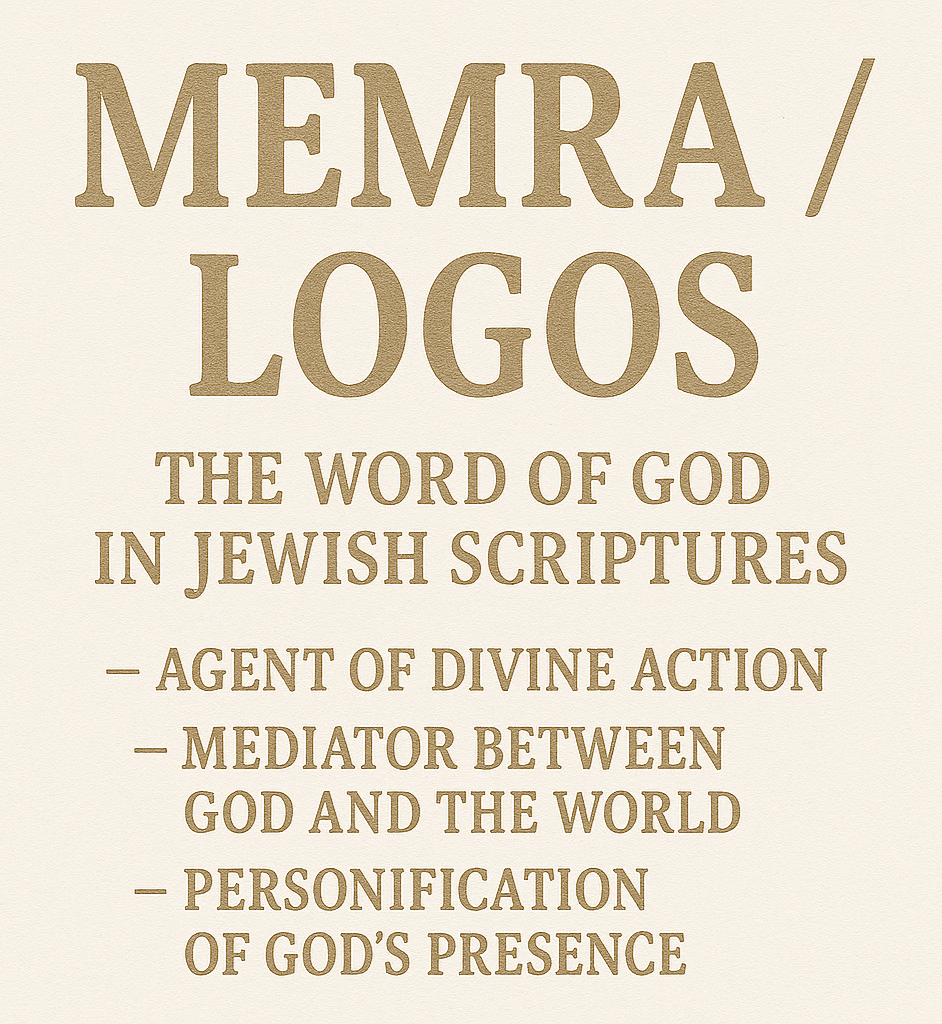
Psalm 138:2 I will worship toward thy holy temple, and praise thy name for thy lovingkindness and for thy truth: for thou hast magnified thy word above all thy name.
Revelation 19:13 And he was clothed with a vesture dipped in blood: and his name is called The Word of God.
Memra, Logos, and the Jewish Word Tradition – The Jewish Logos: John 1 Through the Eyes of Israel
In the beginning was the Word, and the Word was with God, and the Word was God. The same was in the beginning with God. And the Word was made flesh, and dwelt among us, (and we beheld his glory, the glory as of the only begotten of the Father,) full of grace and truth. (John 1:1,2,14)
John opens his Gospel with a declaration that sounds, to many modern ears, like Greek philosophy. But when read through Jewish Scripture, Jewish liturgy, Jewish Aramaic tradition, and Jewish Second Temple theology, it becomes unmistakably clear that John 1 is not a departure from Judaism—it is a deeply Jewish midrash on creation, covenant, and the visible presence of Israel’s God.
This chapter presents John 1 as a Jewish text, using Jewish categories, written for a Jewish audience, and grounded in the same theological world that shaped the Targums, Qumran, Philo, and early rabbinic thought.
1. The Hebrew Foundation: The Word as Creative, Personal, and Active
The Hebrew term דָּבָר (davar)** means far more than “word.” It carries the sense of:
- Action (an event or happening)
- Decree (a command that accomplishes)
- Presence (a manifestation of God’s will)
- Creative power (the agent through which God makes)
Key texts show the davar acting as a personal agent:
- “By the Word of YHWH the heavens were made.” (Ps 33:6)
- “The Word of YHWH appeared again in Shiloh.” (1 Sam 3:21)
- “My Word… shall accomplish what I please.” (Isa 55:11)
In Hebrew thought, God’s Word is not a sound—it is God in action.
John’s opening line—“In the beginning was the Word”—is a direct echo of Genesis 1, where God creates not by tools, but by speech that acts.
2. The Aramaic Foundation: The Memra as God’s Visible, Covenant Presence
In the centuries before Jesus, Jews in the Land of Israel and Babylon read Scripture in Aramaic. The Targums—the official Jewish Aramaic translations—introduced a theological term:
מֵימְרָא דַיוי (Memra d’YHWH) — “The Word of the LORD”*
The Memra is not a metaphor. In the Targums, the Memra:
- Creates (Tg. Neofiti Gen 1:27)
- Walks in the Garden (Tg. Onkelos Gen 3:8)
- Saves Israel (Tg. Isa 45:17)
- Dwells among the people (Tg. Exod 25:8)
- Speaks face-to-face with Moses (Tg. Exod 33:11)
- Judges the nations (Tg. Isa 66)
The Memra is the visible, active, covenantal presence of God.
John’s Jewish readers would have immediately recognized:
“In the beginning was the Memra… and the Memra was with God… and the Memra was God.”
John is not importing Greek philosophy. He is translating Memra theology into Greek.
3. The Greek Term Logos: A Jewish Translation, Not a Greek Innovation
John uses λόγος (logos), but not in the philosophical sense of Heraclitus or the Stoics. Greek-speaking Jews already used logos to translate:
- Hebrew davar
- Aramaic memra
The Septuagint (LXX) uses logos over 1,200 times for God’s Word.
Philo of Alexandria—an observant Jew—uses logos to describe:
- God’s creative agent
- God’s firstborn
- God’s image
- God’s mediator
- God’s presence in the world
John stands in this same Jewish stream.
John 1:1 in Jewish terms
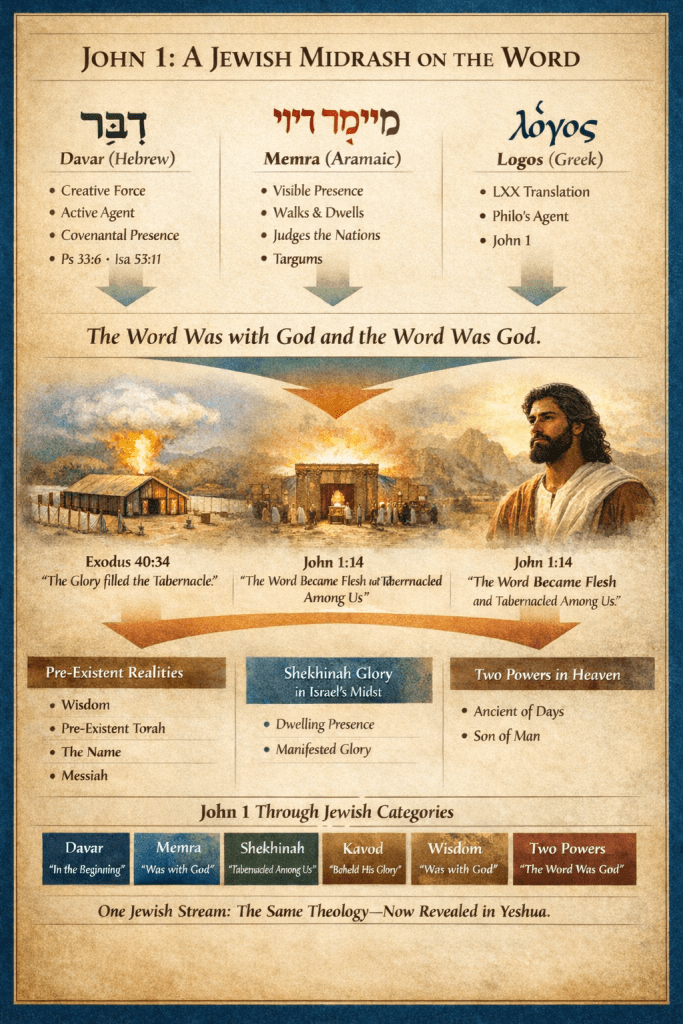
“In the beginning was the Memra,
and the Memra was with God,
and the Memra was God.”
This is the Two Powers in Heaven pattern already present in Daniel 7, Exodus 23, and the Targums.
4. The Tabernacle Motif: “The Word Became Flesh and Tabernacled”
John 1:14 contains one of the most Jewish statements in the New Testament:
ἐσκήνωσεν (eskēnōsen) — “He tabernacled”*
This verb is built on σκηνή (skēnē)*, the Greek word for the Mishkan (Tabernacle).
John is deliberately invoking:
- Exodus 25:8 — “Let them make Me a sanctuary, that I may dwell among them.”
- Exodus 40:34 — “The Glory of YHWH filled the Tabernacle.”
- Targum Onkelos — “The Memra of YHWH dwelt among them.”
John’s claim is unmistakable:
The same Glory, the same Presence, the same Memra that filled the Tabernacle has now appeared in flesh.
This is not Greek metaphysics.
This is Shekhinah theology.
5. The Second Temple Jewish Context: Pre‑existent Agents of God
John’s Jewish audience lived in a world where Scripture and Jewish writings spoke of:
- Pre‑existent Wisdom (Prov 8; Sirach 24)
- Pre‑existent Torah (Pesachim 54a)
- Pre‑existent Name (Exod 23:21)
- Pre‑existent Messiah (1 Enoch 48)
6. The Rabbinic Echoes: The Word as a Divine Hypostasis
Early rabbinic literature preserves the same categories:
- “The Word of the LORD stands forever.” (Isa 40:8)
- “He sent His Word and healed them.” (Ps 107:20)
- “With the Word of the LORD the heavens were made.” (Ps 33:6)
- Genesis Rabbah 1:1 — God creates through His Word
- Tanchuma — The Word reveals God’s presence
John’s Gospel fits comfortably within this Jewish worldview.
7. The Jewish Reading of John 1:14
John 1:14 is the climax of Jewish Logos theology:
“And the Word became flesh and tabernacled among us,
and we beheld His glory,
the glory of the One who comes from the Father,
full of covenantal grace and truth.”
This echoes:
- Exodus 34:6 — “abounding in steadfast love and truth”
- The Glory (Kavod) filling the Mishkan
- The Memra revealing God’s presence
John is saying:
The same Glory that Israel saw in the wilderness is now seen in Jesus.
This is not a break from Judaism.
It is the fulfillment of Israel’s own categories for God’s presence.
8. Visual Chart: Jewish Logos Framework
| Jewish Category | Description | John 1 Parallel |
| Davar | God’s active, creative Word | “In the beginning was the Word” |
| Memra | God’s visible, covenant presence | “The Word became flesh” |
| Shekhinah | God dwelling with Israel | “Tabernacled among us” |
| Kavod | The Glory revealed | “We beheld His glory” |
| Wisdom | Pre‑existent with God | “Was with God” |
| Name | Divine authority | “Only‑begotten from the Father” |
| Two Powers | Heavenly enthronement | “The Word was God” |
9. The Jewish Logos as the Foundation of Apostolic Judaism
John 1 is not a “new religion” or a redactive Christian departure from Judaism.
It is a Jewish revelation expressed in Jewish categories:
- The Word who creates
- The Memra who walks
- The Shekhinah who dwells
- The Glory who reveals
- The Name who saves
- The King who reigns
John’s claim is that all these strands converge in Yeshua, the Messiah of Israel.
Part 7 -The “Son of God” in the Hebrew Bible
 Ask The Teacher
Leave a reply to WORD STUDY Ἁρπαγμός (harpagmos) – Ask The Teacher Cancel reply