
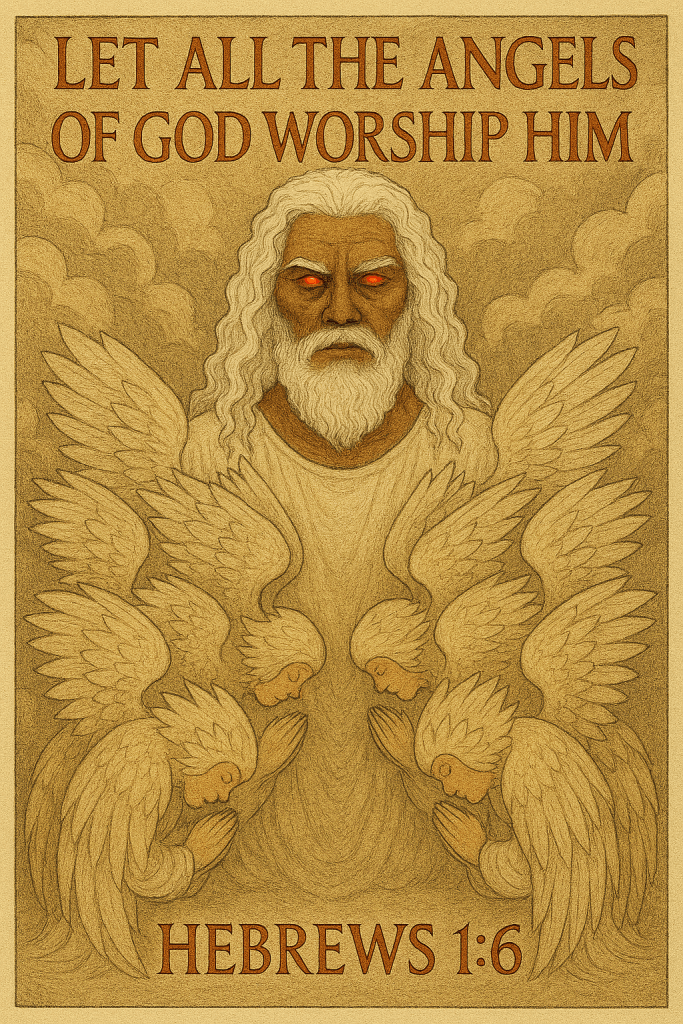
A Jewish Reading of Hebrews 1 and Philippians 2
PART 2 – HEBREWS 1:6 FROM THE PERSPECTIVE OF ISRAEL AND HER SCRIPTURES
1. What Hebrews 1:6 is actually quoting
Hebrews 1:6 (KJV):
“And again, when he bringeth in the firstbegotten into the world, he saith,
And let all the angels of God worship him.”
This line is not in the Masoretic Text of the Torah, but it is in the Septuagint (LXX) version of Deuteronomy 32:43 and is also echoed in Psalm 97:7.
- LXX Deut 32:43 (Brenton):
“Rejoice, ye heavens, with him, and let all the angels of God worship him;
rejoice ye Gentiles, with his people, and let all the sons of God strengthen themselves in him…” - Masoretic Deut 32:43:
Has rejoicing of nations and vengeance language, but no “let all the angels of God worship him.” - Ps 97:7 (MT):
“Worship him, all you gods (כָּל־אֱלֹהִים).”
LXX: “Worship him, all his angels (πάντες οἱ ἄγγελοι αὐτοῦ).”
So Hebrews is standing inside a Jewish Greek Bible where:
- Deut 32:43 explicitly has “angels of God worship him.”
- Ps 97:7 already equates “gods” (elohim) with “angels.”
For a Second Temple Jew using the LXX, this is not a Christian invention; it’s a live Jewish textual tradition.
2. The Jewish context of Deut 32: the Song of Moses
Deuteronomy 32 is the Shirat Ha’azinu, the Song of Moses—deeply Jewish, liturgical, covenantal.
Key themes:
- YHWH as Israel’s Rock (צור), Father, and Redeemer.
- Israel as YHWH’s portion (v. 9).
- Judgment on Israel’s enemies and vindication of His people (v. 36–43).
- Cosmic witnesses: heaven and earth are called to listen (32:1).
In the LXX form of 32:43, the climax of the Song is:
- Heaven rejoices with Him.
- Nations rejoice with His people.
- Angels of God worship Him.
- Sons of God strengthen themselves in Him.
- YHWH avenges the blood of His sons and purges His land.
So in that textual world, the Song ends with a cosmic liturgy: heaven, nations, angels, and “sons of God” all oriented toward YHWH’s vindicating action.
When Hebrews 1:6 cites this, it is not importing a foreign idea; it is reading Jesus into the climax of a Jewish covenant song.
3. “Firstbegotten” as a Jewish category
“Firstbegotten/firstborn” (πρωτότοκος) is a thoroughly Jewish title:
- Israel as firstborn:
“Israel is My son, My firstborn” (Exod 4:22). - Davidic king as firstborn:
“I will make him My firstborn, the highest of the kings of the earth” (Ps 89:27). - Inheritance and preeminence:
The firstborn receives double portion and leadership (Deut 21:17).
So when Hebrews calls Jesus “the firstborn,” a Jew can hear:
- Covenantal status: He embodies Israel as YHWH’s firstborn.
- Royal status: He is the Davidic king elevated as “firstborn” over the kings of the earth.
- Preeminence in the family: Not “created first,” but “ranked first.”
Hebrews 1 as a whole is doing exactly this: stacking Jewish royal and priestly texts (Ps 2, 2 Sam 7, Ps 45, Ps 102, Ps 110) to say: this one is the climactic Son/King.
4. Angels, “gods,” and worship in Jewish thought
In Tanakh and Second Temple literature, there is a layered heavenly world:
- Elohim / “gods”:
Sometimes refers to YHWH alone, sometimes to heavenly beings (Ps 82; Ps 97:7). - Angels as heavenly council:
Job 1–2; 1 Kings 22; Dan 7; the “host of heaven.” - LXX move:
Often translates “gods” (elohim) as “angels,” making explicit that these are heavenly beings, not rival deities.
So when LXX Deut 32:43 and Ps 97:7 say “let all the angels of God worship him,” it’s:
- A council scene: the heavenly host acknowledging the supremacy of the One enthroned.
- A monotheistic liturgy: not many gods, but many heavenly servants bowing to the One.
Hebrews 1 uses this to say:
- Angels are not rivals; they are servants.
- The “firstborn Son” is the one before whom even angels bow.
For a Jew, this is very close to the imagery of:
- Dan 7:13–14: “one like a son of man” coming with the clouds, given dominion, glory, and a kingdom, and “all peoples, nations, and languages serve him” (יִפְלְחוּן). That verb in Aramaic is used for divine service.
- 1 Enoch, 4 Ezra, etc.: exalted human/angelic figures sharing in God’s rule, yet within a monotheistic framework.
5. How to hear “worship him” as a Jew
The sticking point is “worship.” How can angels “worship” anyone but God?
Jewish ways to frame this, using Jewish categories:
1. Representative worship: the king as God’s vicegerent. In Tanakh, honor given to the king is honor to God who appointed him.
2. Bowing to the king (e.g., David, Solomon) is not idolatry; it’s acknowledging God’s chosen ruler.
3. The king can be addressed in God-like language in psalms (Ps 45:6–7) because he is the anointed image-bearer of YHWH’s rule.
From the perspective of Apostolic Judaism:
The angels’ worship of the firstborn is the heavenly equivalent of Israel’s homage to the Davidic king—honor to God’s appointed ruler.
- Shared throne, not rival deity
Hebrews 1:3–4, 8–9 speaks of the Son:
- Sitting at the right hand of the Majesty on high.
- Addressed with throne language: “Your throne, O God, is forever and ever” (Ps 45 applied).
- Yet distinguished from God: “God, your God, has anointed you…”
This is very close to Jewish “two powers in heaven” discussions: a single God, but a complex heavenly identity (Word, Wisdom, Name, Glory, Memra, Metatron) sharing in God’s rule.
From the perspective of Apostolic Judaism:
The worship of the Son is not worship of a second god, but recognition that God has invested His own rule, name, authority and glory in this firstborn.
LXX Deut 32:43 as worship of YHWH in and through His Messiah
In its original LXX setting, “let all the angels of God worship him” is about YHWH’s climactic act of judgment and vindication.
Hebrews reads Jesus as:
- The embodiment of YHWH’s saving action.
2. The one in whom YHWH’s covenant faithfulness reaches its climax.
So the angels’ worship is ultimately worship of YHWH, focused on the one in whom YHWH is acting.
That’s not foreign to Jewish thought:
- The Shekhinah, the Name, the Word (Memra) can be the focus of worshipful attention without splitting God.
6. A way to summarize this as an apostolic Jew
- Textually:
Hebrews 1:6 is reading the LXX form of Deut 32:43 and Ps 97:7, where the angels of God are commanded to worship the one through whom YHWH brings final judgment and vindication. - Covenantally:
“Firstborn” is Israel’s and David’s title. In calling Jesus the firstborn, Hebrews is saying: he is the climactic Israel, the ultimate Davidic king, the heir of all God’s promises. - Heavenly order:
Angels are not competitors but servants. Their worship of the firstborn is the heavenly acknowledgment of God’s exaltation of His anointed. - Monotheistically:
This does not introduce a second god, but reveals that the one God of Israel has chosen to reveal His rule, name, and glory in and through this firstborn Son. The worship directed to him is, in Jewish terms, worship of YHWH as He has chosen to manifest Himself.
 Ask The Teacher
Your voice matters. Iron sharpens iron. What insights or questions do you bring to the table?