
PART 3 – The Textual Backbone: MT, LXX, and Qumran
Did Hebrews 1:6 Change the Bible? The MT, LXX, and Qumran Evidence
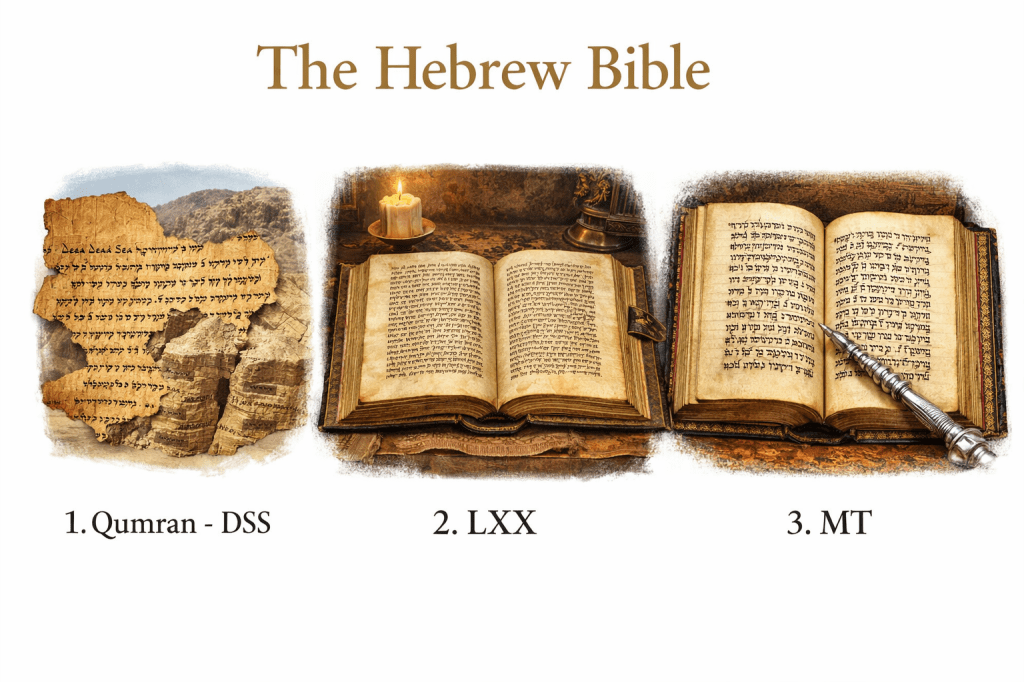
Here is a clear side‑by‑side comparison of Qumran –DSS or The Dead Sea Scrolls, the Septuagint or LXX, and the Masoretic Text or MT for Deuteronomy 32:43 and Psalm 97:7 that shows exactly why Hebrews 1:6 can command angels to worship the Son. These two passages are the textual backbone of the argument.
This is the most important text because the LXX version contains the line that the book of Hebrews quotes:
“Let all the angels of God worship him.”
Table: Deut 32:43 Across Traditions
1. Deuteronomy 32:43 — MT vs. LXX vs. Qumran (4QDeutᵠ)
| Tradition | Text | Notes |
| Masoretic Text (MT) | הַרְנִינוּ גוֹיִם עַמּוֹ “Rejoice, O nations, with His people…”(followed by vengeance and atonement lines) | No angels. Shortest version. |
| Septuagint (LXX) | Εὐφράνθητε, οὐρανοί, ἅμα αὐτῷ· καὶ προσκυνησάτωσαν αὐτῷ πάντες ἄγγελοι θεοῦ· “Rejoice, O heavens, with Him; and let all the angels of God worship Him…” | Contains the angel‑worship line. Hebrews 1:6 quotes this directly. |
| Qumran (4QDeutᵠ) | הרנינו שמים עמו והשתחוו לו כל אלהים “Rejoice, O heavens, with Him; and bow down to Him, all gods.” | Matches LXX conceptually. Uses “gods” (אֱלֹהִים) where LXX has “angels.” |
Key Observations
- Qumran preserves a longer Hebrew text closer to the LXX than to the MT.
- Qumran’s “all gods” = LXX’s “all angels of God.”
- This proves the LXX reading is not Christian invention but an authentic Jewish textual tradition.
- Hebrews 1:6 is quoting a Jewish version of Deut 32:43 that commands heavenly beings to worship God’s chosen one.
2. Psalm 97:7 — MT vs. LXX vs. Qumran
Psalm 97:7 is the second text Hebrews 1:6 echoes.
It contains the same idea: heavenly beings must worship YHWH.
Table: Ps 97:7 Across Traditions
| Tradition | Text | Notes |
| Masoretic Text (MT) | הִשְׁתַּחֲווּ לוֹ כָּל־אֱלֹהִים “Worship Him, all you gods.” | “gods” = heavenly beings. |
| Septuagint (LXX) | προσκυνήσατε αὐτῷ πάντες οἱ ἄγγελοι αὐτοῦ “Worship Him, all His angels.” | LXX interprets “gods” as angels. |
| Qumran | Psalm 97 is preserved in several fragments (11QPsᵃ, 4QPsᵇ, etc.), but 97:7 is not extant. | No surviving text for this verse. |
Key Observations
- MT says “all gods” (כָּל־אֱלֹהִים).
- LXX interprets this as angels (οἱ ἄγγελοι).
- This matches the Qumran pattern in Deut 32:43 where “gods” = heavenly beings.
Thus, both Deut 32:43 and Ps 97:7 share the same ancient Jewish idea:
Heavenly beings—whether called “gods” or “angels”—must worship the one God exalts.
3. Why This Matters for Hebrews 1:6
Hebrews 1:6 says:
“Let all the angels of God worship Him.”
This is not a Christian innovation.
It is a direct quotation from the Jewish LXX, supported by Qumran Hebrew.
The logic is Jewish and consistent:
- MT preserves a shorter version of Deut 32:43.
- Qumran preserves a longer Hebrew version that includes heavenly beings worshiping.
- LXX translates that longer Hebrew version and explicitly names angels.
- Hebrews quotes the LXX because it preserves the older Jewish reading.
This means:
The command for angels to worship the Son is rooted in ancient Jewish Scripture.
It is not a later Christian theological move—it is a Jewish textual tradition.
4. Visual Chart: The Worship Command Across Traditions
| Passage | MT | Qumran | LXX | Hebrews |
| Deut 32:43 | No angels | “All gods bow to Him” | “All angels of God worship Him” | Quotes LXX |
| Ps 97:7 | “All gods worship Him” | Not extant | “All His angels worship Him” | Echoed |
The pattern is unmistakable:
“Gods” = “angels” in ancient Jewish interpretation.
- From the perspective of an Apostolic Jew:
1. Is Jesus God (Elohim)?
2. Is Jesus worshipped?
3. Is Jesus worshipped as God?
These three questions sit at the very heart of apostolic Jewish faith. To answer them faithfully, we need to stay inside Jewish categories, Jewish Scripture, Jewish Second Temple thought, and Jewish readings of the LXX—not later Gentile metaphysics.
The cleanest way to approach this is to treat each question separately, then show how they fit together in a fully Jewish framework.
 Ask The Teacher
Your voice matters. Iron sharpens iron. What insights or questions do you bring to the table?