
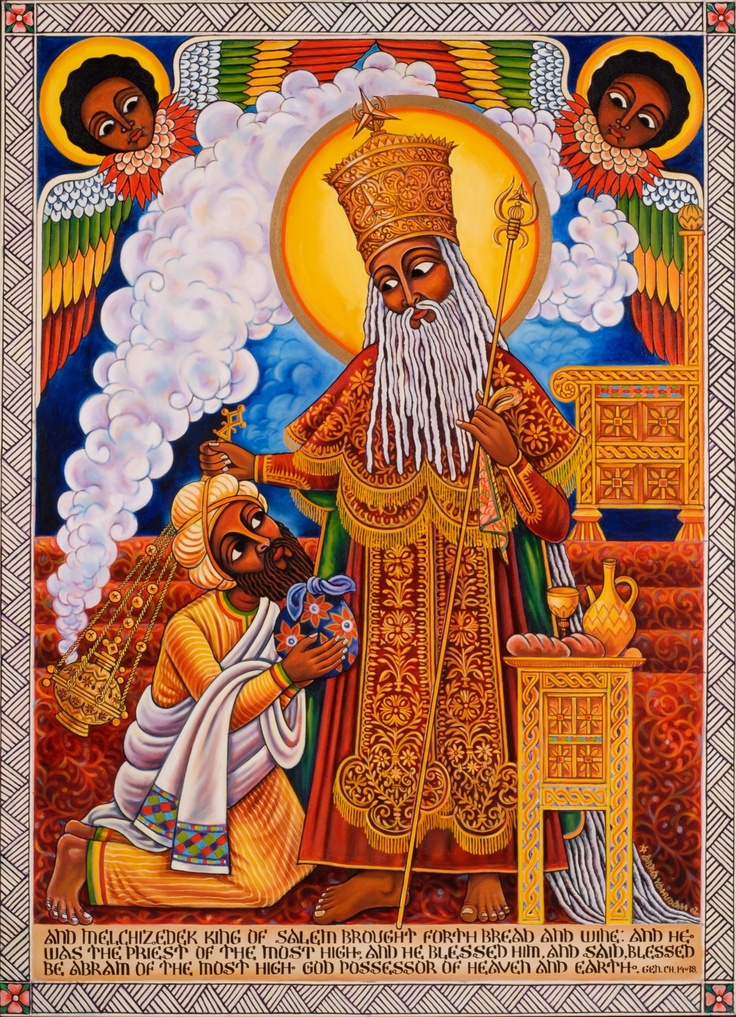
Saint Melchizedek (Qeddus Melkitsedeq). Ethiopian Orthodox icon
Hard to Be Uttered: The Mystery of Melchizedek
“For every high priest taken from among men is ordained for men in things pertaining to God.” – Hebrews 5:1 (KJV)
There are truths in Scripture that refuse simplicity. They are not hidden because they are secret, but because they are sacred—truths that weigh more than they can easily be spoken. The priesthood of Melchizedek is one such truth. It sits at the junction of heaven and earth, history and mystery, theology and geography. The writer of Hebrews confesses this difficulty openly:
“Of whom we have many things to say, and hard to be uttered, seeing ye are dull of hearing.”
— Hebrews 5:11 (KJV)
The phrase “hard to be uttered” (Greek: dysermēneutos) means “difficult to interpret.” It does not suggest that the subject is unknowable, but that it demands maturity of hearing. The mystery of Melchizedek is not an enigma to hide, but a truth that requires readiness to receive.
This series undertakes to speak what has long been considered unspeakable—to unfold what the apostle called hard to be uttered. It approaches Melchizedek not as a divine apparition, nor as an angelic being, nor as a shadowy abstraction of Christ before His incarnation, but as a man—a human patriarch, a son of Noah, and a priest-king of the Most High God or El Elyon in Hebrew.
The thesis advanced here is both ancient in foundation and radical in implication: that Melchizedek was Ham, the son of Noah, patriarch of Canaan, and priest-king of Salem—the city that would later be called Jerusalem. This proposition does not arise from conjecture, but from Scripture’s own geography, genealogies, and the logic of divine blessing.
The Order of Blessing: A Forgotten Key
In the book of Genesis, blessing is not an emotional wish but a transmission of divine authority. Blessing flows downward—from the greater to the lesser, from the elder to the younger, from the one who holds divine commission to the one who receives it. When Abraham received a blessing from Melchizedek, the writer of Hebrews makes the principle unmistakable:
“And without all contradiction the less is blessed of the better.”
— Hebrews 7:7 (KJV)
If Melchizedek blessed Abraham, then Melchizedek was greater than Abraham. But who could be greater than the man called “the friend of God” and “the father of the faithful”? (James 2:23; Romans 4:11). The answer must be found in
The Divine Order of Blessing.
Only Noah and his sons—Shem, Ham, and Japheth—were blessed by God before Abraham (Genesis 9:1). They alone stood as the patriarchal heads of all post-flood humanity. Therefore, only one of them could occupy the priestly station higher than Abraham’s. If Melchizedek is described as both king and priest, ruling in the land of Canaan and blessing the patriarch of Israel, then his identity must belong to the blessed line that presided over that land.
The land of Canaan belonged not to Shem, but to Ham. Scripture records this clearly in the Table of Nations (Genesis 10:6–20). Canaan and his descendants—the Jebusites, Hittites, Amorites, and others—are all listed as sons of Ham. The land of Salem, later Jerusalem, was theirs. Thus, when Abraham met the “king of Salem,” he encountered a priest-king who ruled in the inheritance of Ham, not Shem.
A Radical Reconsideration
Jewish and Christian tradition have long identified Melchizedek as Shem, reasoning that Shem was the most righteous of Noah’s sons and that monotheism must have passed exclusively through his line. This interpretation preserves theological neatness but ignores the geographical realities the Bible itself records. Shem’s descendants dwelt east of the Euphrates—in Mesopotamia, Assyria, and Elam. Ham’s descendants dwelt in Canaan, Egypt, and Cush. Salem stood not in the east, but in the west—in the land of Canaan, under Ham’s domain.
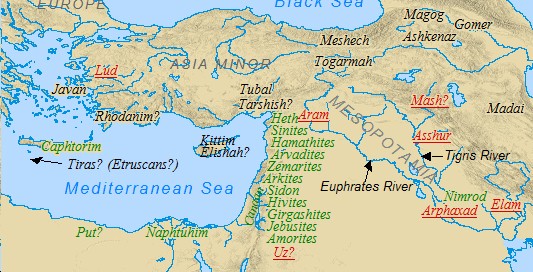
If Melchizedek were Shem, he would be a priest-king reigning far outside the boundaries assigned by the Most High, crossing into territory given to his brother. But Scripture affirms that the boundaries of nations were set by divine decree:
“When the most High divided to the nations their inheritance, when he separated the sons of Adam, he set the bounds of the people according to the number of the children of Israel.”
— Deuteronomy 32:8 (KJV)
To place Shem in Canaan as king would be to disregard the divine division of land. To place Ham, however, aligns with that order perfectly. Ham’s line inherited Canaan; Ham’s son Canaan fathered the Jebusites; the Jebusites founded Jerusalem. The king of Salem, then, was a Hamite ruler serving as priest of the Most High God—a righteous remnant within a lineage later marred by idolatry.
Why This Matters
If this is so, the implications are immense. It means that God’s first priest-king after the Flood was not drawn from the “righteous line” of Shem, but from the line long accused of corruption. It means that the grace of God reached beyond genealogical privilege, raising up a righteous priest from a line others despised. It means that divine blessing could sanctify what human tradition had condemned.
This interpretation reclaims Ham from the shadows of misreading. It restores the honor of a patriarch whose name has been wrongfully darkened by the so-called “Curse of Ham,” a curse that Scripture never pronounced. It transforms the story of Melchizedek from a mere curiosity into a revelation of divine reversal—of judgment transfigured into mercy, of servitude turned to sacred service.
The Priesthood Beyond the Covenant
Melchizedek’s priesthood stands outside the Levitical system, centuries before Sinai. It is not a priesthood of law, lineage, or ritual, but of righteousness and peace. It reveals that worship of the Most High God was not the exclusive inheritance of Israel, but the universal calling of humankind.
Ham, if indeed he was Melchizedek, becomes the symbol of this truth: that divine revelation was never confined to one lineage alone, but moved through the nations in hidden streams of faith and obedience. The same God who divided the nations by boundary also bound them by priesthood. The same hand that cursed Canaan sanctified his land by the presence of a righteous priest.
An Invitation to Deeper Hearing
The writer of Hebrews hesitated to speak of these things, saying they were hard to be uttered. Yet the time has come to utter them—to draw from the deep well of Scripture the truths long buried under tradition. To see Ham not as a byword, but as a servant of God; not as the father of a curse, but as the priest of righteousness; not as one cast out, but as one called up.
The mystery of Melchizedek is the mystery of restoration itself—the pattern by which God exalts the humbled and redeems the rejected. In the chapters to follow, we will trace this pattern through genealogy, geography, and divine typology, uncovering how the land of Canaan became the stage of redemption, and how the priesthood of Ham prefigured the eternal priesthood of the Messiah, the true King of Righteousness and King of Peace.
“Of whom we have many things to say, and hard to be uttered…”
— Hebrews 5:11 (KJV)
 Ask The Teacher
Your voice matters. Iron sharpens iron. What insights or questions do you bring to the table?